Quiet tea, talky tea

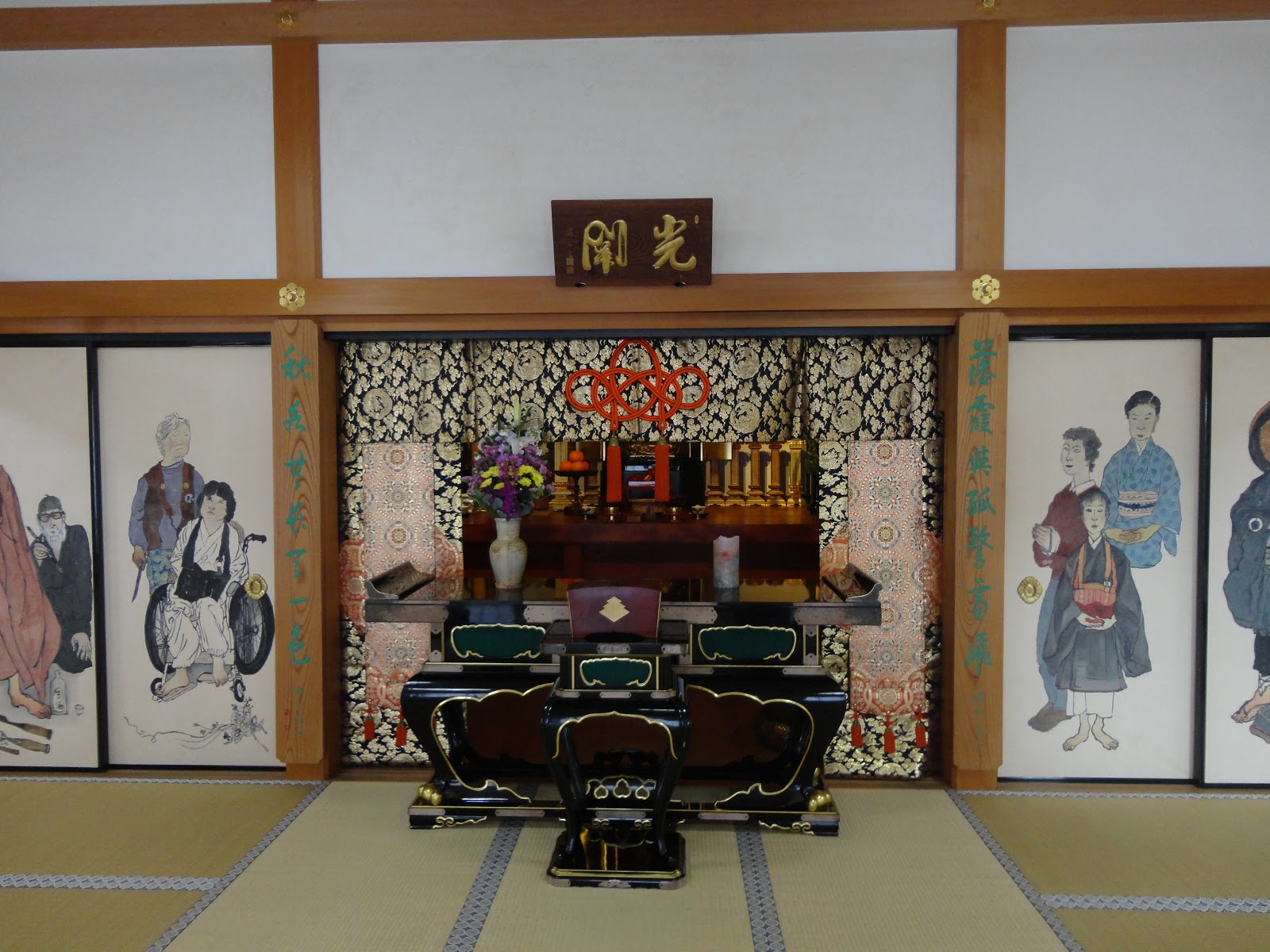
Butsuma--a space for the Buddha. Chanoma--a space where people drink tea, eat, chat.

Tuesday, September 24, 2013

Memorable temples--Gokokuji

The temple Gokokuji
The Niomon (gate with two guardian figures)


I first visited Gokokuji (mountain name: Shinreizan) six or eight years ago.  I was just finding out about esoteric Buddhism (called mikkyo in Japanese) and I didn't know there was esoteric Buddhism in Japan.  But there was a Tibet festival at the temple, so I went for a look.  There was an outdoor goma, or fire ceremony, conducted by the leader of the visiting Tibetan group.  There was a sand mandala, which I saw being created.  For the occasion, the temple opened the main altar, which is normally kept closed.  The image inside the altar is an example of a hibutsu, an image that is not normally shown to the public.  Well, I thought it might be cool to see something that is not normally shown to the public, so I went into the main hall.  However, my memories of that visit are pretty vague--I think I was still influenced by my experiences in a very exclusivist Nichiren-based organization that discouraged visiting temples of other sects.  The image in the altar is Nyoirin Kannon, which I had never heard of at that time.  However, I remember that the statue was rather dynamic, with head tilted, seated with one knee up, a rather sensuous pose compared to most Buddha statues.   

The main hall, Kannon-do, dedicated to Nyoirin Kannon

This hall is nearly intact from the 17th century


I recently visited the temple again, finding out a lot more interesting information.  The temple was founded in 1681 and the main hall is pretty much as it was when originally constructed in 1697.  It was founded by Keshoin, who was the mother of the shogun Tokugawa Tsunayoshi.  Keshoin dedicated the temple to the memory of her deceased son.  The interior of the hall is richly decorated, although much of it is darkened by time as well as the smoke from incense and candles.  Nyoirin Kannon is a form of Kannon that embodies both motherly love and invincible power against negativity.  There are around 33 different forms of the Bodhisattva Kannon--the 1000-arm one is well-known, the 11-headed one is very common, but Nyoirin Kannon is a bit unusual, in my experience.  

Two views of the esoteric Treasure Tower


I took my temple stamp album into the main hall.  The monk in charge did the calligraphy while I looked around the main hall.  There are lots of very old statues, and there was also a modern-looking oil painting of Kannon riding on a dragon.  After giving me the temple stamp, the monk told me a few things about the temple's history.  There is a group of statues on either side of the main altar, which the monk explained, are all the forms of Kannon.  These statues were commissioned by Keshoin after the death of her son, when she signaled the end of her worldly life by cutting her hair.  Some of her hair was put inside each of the statues.  These were dedicated in the hope that her son would soon reach enlightenment.  Motherly love!

The gate of 'no aging'

A guardian figure


Other notable features of the temple include the treasure tower (29th c.) and a guest reception house that was moved from the famous temple Miidera in Shiga Prefecture. Also, there is a gate with the inscription 'Fu Ro' meaning 'no old age.'  The inscription is in the handwriting of the shogun Ietatsu.  The temple is easy to find; there is a subway station named Gokokuji, and the relevant exit brings you out right in front of the Nio Gate.  Also, the altar of Nyoirin Kannon is opened on the 18th of every month.  The altar is opened during the sutra recitation starting at 9:00 AM, open to the public.  A free brochure has information about the temple in English

A leaping 'shishi' on the base of a large lantern

This gate is in the style of a samurai estate rather than a temple


Guest house from the temple Miidera


Monday, August 19, 2013

Tea in ancient Korea

I had to link this--the article mentions that in the unified Silla kingdom, aristocrats would sit in front of a   Buddha statue and drink Tea!

http://buddhismnow.com/2013/07/30/tea-in-korea-by-sonhae-sunim/#more-6102

(hmm...the link function is not working, feel free to copy and paste into your browser)

Tuesday, August 13, 2013

Clothes make the man? or Don't judge a book by its cover? A view from Japan


Conclusion first: I think Japan would go with 'Clothes make the man.'  As part of the 'hippie' generation, I used to think this was a very shallow view.  I much preferred the other proverb.  But I am beginning to see things a bit more in the Japanese way.  Originally, I saw it as a surface thing--a man who wears expensive clothes will be perceived as better.  We resist the notion that a good person who can't afford fancy clothes is maybe less of a person.  But the Japanese view is a bit different: clothes are a reflection of your personality, or even your will or intentions.  The soldier strapping on armor before battle feels a congruence between the act of putting on the armor and the will to prevail in battle.  This is by no means unknown in the west.  Football players must feel something like this as they put on their gear before the Friday night or Sunday afternoon games.  Ancient Greek warriors described in Homer's epic works are always 'girding their loins' --this is a metaphorical way of expressing the mental preparations for battle. But the Japanese white-collar worker also feels this putting on his necktie before charging into the morning commute.  Many years ago, I was surprised that so many Japanese would spend so much time and money on their appearance.  Much of it is just 'image,' but that is no trivial matter.  How you look determines how people will treat you, and ultimately, it is tied in with your destiny.

The more serious the chef, the snappier the whites

Japan is big on uniforms.  A majority of school kids wear a school uniform somewhere along the line.  Department store greeters that push the elevator buttons are always dressed in snappy uniforms.  Sushi chefs are required to wear whites, while most other Japanese chefs also go for the snappy look.  We expect police, pilots and other safety-oriented workers to wear uniforms.  In Japan, this applies down the line to the lowliest train platform crew.  The public is reassured by this.  But this is nothing shallow.  There may be some deep-level influence of Buddhism in this.  Many Buddhist traditions mention the importance of body/action, speech and mind.  These are the source of actions that determine your karma.  Ideas originating in your mind can become speech.  Speech can become action.  Action is your karma, so paying attention to all three is necessary.  It is the intention comes to the fore.  To what use will you put these forces?  Unfortunately, there are lots of people don't give it a second thought, or even a first one.  

Early on, I noticed that Japanese people do not react to sarcasm.  Much of my sense of humor relies on sarcasm, but they just didn't get my jokes.  I have come to believe that the intentions implied by speech are not trivial.  The worst case would be joking about killing or violence toward a friend or family member.  This is pretty unthinkable for most Japanese.  (I do a lot less sarcasm these days.)  Likewise, pranks do not really work here, because of the intent to make someone look foolish.  There was a show like Candid Camera here, but the targets of the pranks were always celebrities who had been set up.  Ordinary members of the public were never targeted.  

These notions can overlap a bit into the realm of magic, including spells, mantras and other vocalized esoteric practices.  I was involved in some musical performances at a hospital, where I was advised, as a matter of common sense, not to program Chopin's piano etude no. 3.  The reason?  It is known in Japan as 'Wakare no Kyoku' or the Song of Farewell.  No one would want to plant the seed of farewell in the mind of anyone in a hospital.  Speaking of hospitals, one should never bring a potted plant as a gift to a sick person--the disease could 'take root.'  (Cut) flowers are a much purer expression of hopes and good wishes.
Girding my loins before a performance

Speaking of music, musicians here pay lots of attention to their clothes.  For traditional Japanese music, performers always wear traditional clothing, usually on the formal side.  There are similar traditions in the west--major European orchestras often perform wearing white tie/tails.  In pop/rock genres, the Japanese also give considerable thought to their appearance, no matter how casual it appears.  Ya gotta look the part.  

These ideas have given me a lot of insight into some of the differences in attitudes and thinking that I have encountered in Japan.  There is a famous Buddhist saying: If you can understand the mind, you understand everything.  Even my superficial investigations of the esoteric Buddhist theories of body, speech and mind have given me a lot to think about.  I also must say, there are a lot of people in this world who would benefit from a bit more attention and care in these realms.  

Tuesday, July 2, 2013

Shakyo 写経

This copy of the Heart Sutra was made in the 8th or 9th century, from the collection of TNM


Copying scriptures

Sutra copying is a time-honored practice that goes back to the days when there were no copy machines, and even the ability to read and write was in short supply. I have made sutra copies on various occasions in the past but I just joined a new group that meets once a month, so I will be doing it more regularly, I hope.  Having seen several procedures for how to do it, I thought I would write about some of the common elements of the copying practice.  

In the old days, donating a copy to a temple was a pretty big deal.  Nowadays in Japan, it has become a way for lay people to deepen their practice.  I don't know if sutra copying is common among lay people in Theravada traditions; please comment if you know that Theravadists also do this.  In Japan, sutra copying is related to the seal/stamp/chop culture, imported from China along with the Chinese writing system.  In the old days, when someone donated a sutra copy, the temple would stamp its elaborate official seal as a kind of receipt acknowledging the donation.  In Japan, that evolved to the point where many temples now offer the seal impression in return for a monetary donation.  This is called 'go shu in' ご朱印 literally 'red stamp.'  Many people collect them in special albums constructed with accordion-folded paper and hard boards as covers.  The most common pattern: a central red stamp represents the main object of worship of the temple.  In the case of mikkyo (Buddhist temples of the esoteric tradition), this is likely to be a Sanskrit letter.  Another stamp near the upper right corner shows the name of the temple, along with characters referring to a donation. In the lower left is the official stamp of the temple.  Then, the name of the Buddhist deity is written with ink down the center of the page, while the name of the temple and the date are added, usually near the corners.  The people doing this writing are often skilled calligraphers, so having a 'go shu in' collection can be impressive in terms of both the calligraphy and interesting aspects of the elaborate stamps.  For Buddhists, these collections are considered to be an embodiment of Buddhism, so the albums are treated respectfully and often kept on the home altar.


However, I recently visited a temple where you have to make an actual sutra donation in order to get a stamp!! So, this brings us back to the main topic of sutra copying.  As you might expect, there is a special procedure for this.  Essentially, the idea is to purify oneself and the room, invoke the Triple Gem, do the copy, and dedicate the merit.  In more detail:

1) Clean the room and purify (usually incense and candles)
2) Make sure your clothes are clean, appropriate and put on properly
3) Wash hands and face, rinse mouth (toothbrushing also good!) as personal purification
4) Arrange a table with the tools: copying paper, writing brush, paperweight, water dropper (for ink grinding), grinding stone, ink block etc.
5) Bow and invoke the Triple Gem: The Law, the Buddha, the Sangha
6) Sit down properly
7) Read through the sutra aloud
8) Think of your wish or purpose for copying
9) Copy the sutra, maintaining a pure and selfless mind
10) Write your wish and your name/date
11) Dedicate merit to all living beings
12) You may now leave the room. 

This is a special way of collecting temple stamps. This shows one stamp from each temple on a pilgrimage route--this one dedicated to the Bodhisattva Kuan Yin/Kannon
Left: Fudo Myo O at the temple Takahata Fudoson. Right: the 1000-arm Kuan Yin, Kiyomizu Do in Ueno Park

I went to a calligraphy supply shop to buy a writing brush (the temple supplies ink blocks and grinding stones).  It is an amazing shop.  When you walk in, the smell of ink envelops you--tar, incense and mothballs might be one way to describe it.  There are thousands of brushes from China and Japan, as well as paper, ink (liquid and block), grinding stones, brush racks, stones and tools for carving your own stamp--it goes on and on.  There was a section for sutra copying paper, and displayed on the wall was a very special sutra copy.  It was very beautiful paper, flecked with gold, and there was a gold lotus flower at the bottom of each character space--each character is a Buddha in a way, sitting on a lotus throne.  The inscription indicated it was by a 70-year-old woman, who was praying for someone's recovery from illness.  The letters were written so perfectly and beautifully it could take your breath away.  
I made this copy as part of a campaign for 10,000 sutra copies shortly after the Fukushima Tohoku disaster


I think there is a lot to be gained by copying scriptures.  I hope that there are also non-Buddhists pursuing copying as a spiritual exercise.  Please comment if you have experience or stories along these lines.

Sunday, April 14, 2013

The temple Jinguji in Matsumoto

Beauty and compassion

Weeping cherry tree at the gate of the temple Jinguji
I had the privilege of visiting this temple, participating in ceremonies there, as well as performing in some concerts.  Records of the founding of the temple no longer exist, but it was a Shingon temple at one time.  Now it is in the Myoshinji branch of the Rinzai Zen tradition.  There are some rather old images and structures, and it is certainly very scenic.  However, the temple's chief priest is certainly one of its biggest assets.  
This flame is said to be from the atomic bombing of Hiroshima

The raked garden.  The stairway leads to the hall of Medicine Buddha

Hall of Medicine Buddha

The temple is located in the Asama Onsen area near Matsumoto in Nagano prefecture.  The onsen (hot spring) zone is rather quiet these days--once it was quite lively, with a geisha community as one of the attractions.  Now it is mostly quiet but classy inns that are proud of their bathing facilities. 

There are many temples with the name Jinguji, since the name refers to a certain movement to establish Buddhist temples (ji) joined with 'Shinto' shrines (jingu).  But that was a long time ago.  There is still a shrine near the temple, but otherwise, the temple has nothing 'jingu-ish' about it.  
The covered corridor is the approach to the main hall

Avalokitesvara in the lobby of the multi-purpose hall
The chief priest, Rev Takahashi (usually called 'Jin-san') is devout, open-minded, innovative and especially devoted to nuclear accident-related causes.  Right after the nuclear accident in Chernobyl, he visited that area some 30 times to assist with aid efforts.  He is now working to aid victims and improve government response and regulations after the Fukushima tsunami/nuclear accident.  
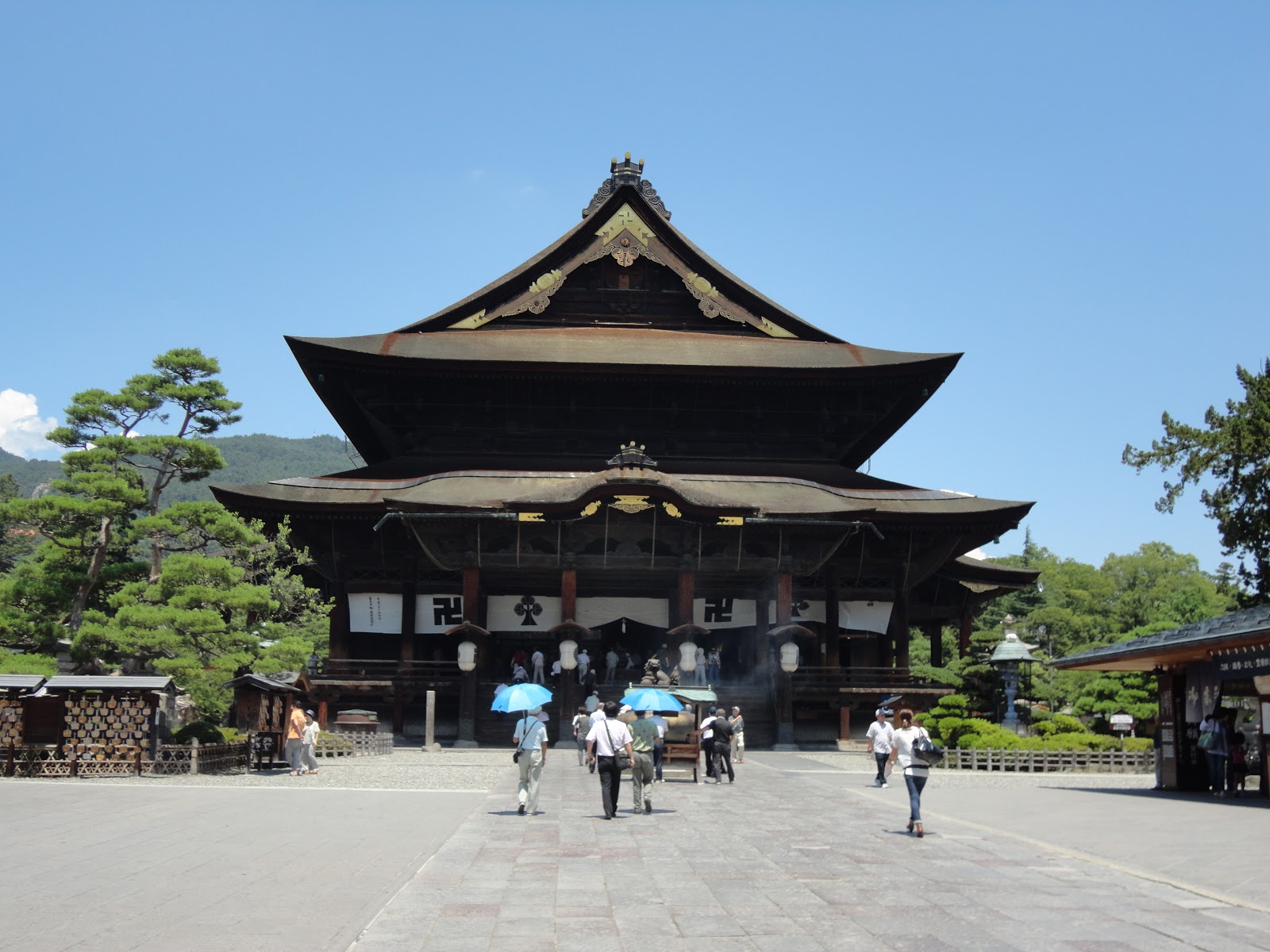
In addition to all that, he has a congregation (danka) to care for.  I saw him in action over the weekend.  The main hall of the temple is in the style of a high-class mansion of the old days--in the past, devout nobles would convert their mansions into temples, meaning that the space is usually large, covered with tatami mats, but the ceiling is of a height more suitable for residential use.  The altar in the main hall of Jinguji is dedicated to Shakyamuni.  It is beautiful, but the space not really suited to the needs of the large congregation--more people want to sit in chairs these days, rather than on the matted floor, for one thing.  So Jin-san decided to build a multi-purpose hall.  This was where the events I participated in were held.  The building is pretty much like a school multi-purpose room, except that there are about 35 niches with altars built into the side walls.  They are all identical black shrines with gilded statues inside, so the atmosphere is definitely Buddhist. 
The altar of the main hall

A shrine to the baby Shakyamuni

Worshippers can ladle amacha over the statue
This hall holds up to 300, and we did the same ceremony/event three times, so the total attendance might have been nearly 1000.  The concept was a combined service of the 'Hana Matsuri' (celebration of the birth of Shakyamuni, usually observed on April 8, but a few days later in this case), plus a remembrance of all who passed away in the past year, as well as victims of the Fukushima disaster and the Kobe earthquake.  Two other musicians and I were asked to participate.  The stage setting was simple, but with several large flower arrangements.  There was a crystal basin on a plexiglass stand, with the typical baby Shakyamuni statue (he is standing and waving his hand, able to walk and talk at birth).  The basin is filled with a kind of herbal tea 'amacha' which is poured over the statue with small ladles.  This was set up in front of a projection screen.  The service started with beautiful photos of cherry blossoms (just in season in Matsumoto), accompanied by tsuzumi sounds.  Then, a narrator started to relate the life of Shakyamuni, as Mr. Mikio Tsuji accompanied on his 11-string alto guitar.  Next, the chief priest of another temple did a 'goeika,' a kind of hymn.  She accompanied herself with a small bell and tiny gong.  Then, Jin-san entered and symbolically poured amacha over the Shakyamuni statue.  Next, he did three formal prostrations after first unfolding a ceremonial kneeling cloth.  Then, he dropped some 'shoko' incense chips in his censer and started to recite the Heart Sutra.  He has a very unusual way of doing this, with variations in tempo that emphasize certain meanings.  I joined in with tsuzumi--a rather unusual combination, and then Tsuji-san started with the guitar and Mr. Yoshiharu Karino added his flute.  The other chief priest also joined in the recitation, having practiced with Jin-san before. 
Alcove in our 'green room'

Three musicians in the 'green room'

The bell tower, with another weeping cherry
Finally, the 'Gyate gyate' section was repeated three times with no accompaniment.  Next was the time for the congregation to offer shoko incense while pictures of the deceased were projected, and Jin-san read the names on the symbolic stupas, the 'otoba.'  The service ended with the usual dedication of merit, 'e ko.'  Part two was a mini-concert by the three musicians.  Then, in part three, a survivor of the Fukushima disaster was introduced for an interview.  She has become an activist for both rehabilitation/recovery and monitoring of government responses.
This old traditional building is Kiku no Yu

The bath is decorated with stylized chrysanthemums


Tsuji-san and Karino-san waiting for dinner 

First course: basket of goodies with cherry blossoms
We did the first ceremony on Saturday afternoon.  Then, we went to the 'Kiku no yu' or Chrysanthemum Bath.  It was actually an inn with a bath, and the inns seem to follow this name pattern, always 'The (something) Bath' rather than 'The (something) Inn.'  We had the upstairs dining room reserved, so we left our stuff in the room and went to the ground-level bath.  There was an enclosed garden to enjoy while soaking.  Then we went back upstairs for an incredible multi-course meal.  

The next day, we did the program at 10:00 and 2:00.  We finally left Jinguji around 4:30 or 5:00.  Another remarkable thing about Jinguji is that there is a group of Mongolian refugees that work there.  I wasn't able to find out how they ended up at Jinguji, but they were lucky to have Jin-san sponsoring them.  They worked with a crew of younger Japanese, handling parking, ushering during the service, stage operations, sound and lighting as well as setting up the 300 chairs and putting them away afterward.  Mrs. Jin-san was wonderful, kind and soft-spoken.  She gave us amacha herbal tea to drink, and gave us boxes of pastries to take home.   And to think, they actually paid me to do this.  

(Click on photos to see larger versions)

Tuesday, January 8, 2013

From Darkness into Light

Temples dedicated to Amida use gold to make a strong impression of light

Temple Darkness Experience
  1. Light is a basic metaphor of Buddhism--the whole thing is to find en-LIGHT-enment, right?  To stimulate people to think a bit about enlightenment, some temples offer a darkness experience, which can give you a refreshed view of light.  The temple Zenkoji in Nagano City has a famous darkness experience.  Inside the main hall of the temple, there is a staircase going down into a completely dark hallway.  At the bottom of the stairs, you put your right hand against the wall and proceed, unseeing, into the darkness.  After going around a corner or two, your hand will encounter a traditional Japanese lock holding something closed.  This means that you are directly under the statue of Amida Buddha (a Buddha of light) in the main altar.  You can rattle this lock and pull on it as a sign of your desire to go to the Pure Land of Amida.  The darkness symbolizes ignorance and death, while the Pure Land is a kind of heaven which you can reach after death by believing in Amida.  So this act is a kind of rehearsal or simulation of death.  But you are really still alive, so you can proceed onward, finally reaching another stairway up to the main hall.  Near the top of the stairway is a large mirror, allowing you to see your 'reborn' self for the first time. 


The main hall of Zenkoji
Temple stamps can be obtained when making a donation.  This one shows Amida.
The Pure Land school of Buddhism is widespread in Japan, although Zenkoji was founded without affiliation to any particular sect.  Nowadays, ceremonies are conducted by priests of both Pure Land and Tendai traditions.  The Amida statue at Zenkoji is a 'hibutsu,' or secret Buddha, that is never exposed to view.  There is no explicit reason for this, but one can imagine it is to stimulate the desire to meet Amida.

Gyokushin Mitsuin
Near the southwestern edge of Tokyo is the temple Gyokushin Mitsuin, commonly known as Tamagawa Daishi.  The Daishi, or Great Master, in this case, is Kobo Daishi, who studied Vajrayana Buddhism in China and established Shingon Vajrayana Buddhism in Japan.  This temple seems rather unassuming--the roofline is not especially high, and the grounds are not spacious.  There is a small garden with several stone Buddhas and several gongs and bells that can be rung, using the sense of hearing as a drive to enlightenment. 
Kongosho, a ritual implement

You can enter the main hall to approach the altar of Kobo Daishi. The priest is very likely to offer greetings and a short chat (in Japanese) if you are interested. Here there is also a stairway down to a world of darkness. The priest recommends repeating 'Namu Daishi Henjo Kongo' as you descend into the darkness. Again, you use your right hand on the wall as you proceed. Soon, you will find a kongosho or vajra ritual implement in a niche in the wall. You can hold onto it, visualizing its power of protection. As you continue, the path curves around, while there are also upward and downward slopes. Finally, you emerge into the brightly illuminated Henjo Kongo Den, a cave-like temple with hundreds of stone Buddhas of various sizes. Among them, Dainichi Nyorai (the Cosmic Buddha, also a Buddha of light) and Kobo Daishi are prominent. There are also 88 statues that allow you to replicate the pilgrimage to 88 temples of Shikoku Island. Another suggestion of the priest is to find the number among the 88 that corresponds to your age, and make a wish (I guess if you are 89 or older, you start again from no. 1). There are statues of Avalokitesvara/Kuan Yin and many other Buddhas. There are twelve Buddhas that correspond to the 12 animals of the Chinese zodiac, allowing you to find your personal Buddha based on your birth year. Finally, as you leave, there is a large gong which you can ring to announce the successful completion of your mini-pilgrimage. I bought a nice representation of a kongosho that you can attach to a phone or handbag as a reminder of the pilgrimage, and a copy of the Heart Sutra that is small enough to be used in the same way.
  

Amida Buddha

Friday, October 19, 2012

Kimono experience

Costume from the Kabuki dance, Wisteria Maiden


A friend asked me to help out at a kimono experience that was expected to attract a lot of foreigners.  There were several events in Nihonbashi, the center of Tokyo, that coincided with the IMF meeting in Tokyo.  The event I went to had two parts: an exhibition of Kabuki costumes and a kimono-wearing experience.  

The costume exhibition was combined with two lectures (in Japanese) about costumes.  There was no attempt to provide English translations, but for the exhibit, there were English handouts of the character and play associated with each costume, as well as a bit about the materials and style of the costume.  An expert from a major Kabuki production company came to give a lecture (which required a paid ticket) which I did not attend.  However, after the formal part of the lecture, the expert went to the exhibition room and made some remarks about the costumes.  Perhaps the most impressive comment was that one of the costumes would cost 'nan-zen man' in yen to recreate.  'Nan-zen man' translates to 'hundreds of thousands of dollars!'  This costume had huge hand-embroidered decorations on top of a heavy brocade robe.  Part of the problem is that there are not many artisans who still know these techniques.  This robe, plus the wig and sash to complete the costume, could weigh nearly 100 pounds.  There were three heavily embroidered robes that were worn by main characters.  There were also three kimonos worn by the 'maids' that had dramatic dyed patterns of phoenix feathers in bright, neon-like colors.  But the experts said these were 'plain' in comparison to the embroidered kimonos.


Kimonos and sashes


The kimono experience was run by Sasajima Sensei, a teacher of kimono wearing.  (Maybe you didn't know there were teachers of kimono wearing.)  For no charge, visitors could select a kimono and sash and other accessories.  Then, a flock of able assistants would flutter around, helping in the process of layering of robes, tying of various cords and sashes, and adjusting every fold to perfection.  For women, there were the trailing sleeves usually worn by younger women as the flashiest fashion, as well as the shorter-sleeve version worn by others.  These were in beautiful brocades, hand-dyed, some were hand painted, some woven with gold thread, with patterns ranging from flowers and seasonal themes to abstract patterns.  For men, the only choice was the black kimono worn with hakama trousers for a formal occasion like a wedding.  I am pretty sure these were all genuine silk, so the prices for these outfits would certainly be in the 1000s of dollars, many of them more than 10,000.  Once all the fussing was over, the visitors could stroll around the lobby and have photos taken in front of a gold screen and red umbrella.  One visitor wore her kimono to an IMF meeting, and some were able to enjoy rickshaw rides (another part of the series of events) showing off their finery.

There were no cross-dressing requests, but some of the physical types presented a bit of a challenge.  A tall black woman--a body type similar to, say, Michele Obama--asked if pregnant women could do this (the obi sash is often pulled very tight for the most fashionable look).  Sasajima Sensei took on the challenge, with assurances that she could adjust everything to avoid obstetrical problems.  The visitor chose a light aquatic sky blue that presented a beautiful contrast with her ebony color.  Another challenge was a young girl who was about six or eight years old.  An adult kimono was tailored by a quick basting--no cutting-- that turned out very well.  

The event was available for three days.  The first day, there were only a few takers.  Then, word began to spread, and the numbers picked up.  On Saturday, the last day, the kimono ladies were rushing practically all day.  There were only three men who tried it, but probably 30 or 40 women.  It was a great opportunity to enjoy the high-quality artisanal experience that would normally require a considerable charge (for example, renting a kimono for a wedding or something). 
(Yamada-san admires a Kabuki costume while displaying her own fancy obi bow)