Quiet tea, talky tea

Butsuma--a space for the Buddha. Chanoma--a space where people drink tea, eat, chat.
Showing posts with label temple. Show all posts

Saturday, January 4, 2014

Memorable temples--Sensoji in Asakusa, Tokyo


Almost every tourist in Tokyo has visited Sensoji--it is definitely among the top sights to see.  It is less well-known that the temple is the oldest one in Tokyo, founded in 645, according to Wikipedia.  The story: two brothers fishing in the river netted a small statue of Kannon (Kuan Yin or Avalokitesvara).  The village headman put the statue on display, which attracted many worshippers.  The temple was founded to house this statue.  To the right of the main hall, there is a shrine dedicated to the two brothers and the village headman.  Every other year, this shrine is the focus of a major festival, the Sanja festival.  Sanja refers to the three deified villagers enshrined there.  It is a prime example of the alliance between (so-called 'Shinto') shrines and (Buddhist) temples.  Anyway, back to the temple of Kannon.  The temple was visited by the famous monk Jikaku, who made a copy of the statue.  Some members of the Tokugawa family of shoguns patronized the temple; some of them (or some other patron) may be responsible for the famous Kaminari Mon gate.  This gate is a bit unusual, because it has representations of the gods of wind and thunder.  This may be for protection against storms and flooding, and is possibly related to another watery deity, the Dragon King, one of the supporters of Kannon. The subway station exits are near this gate--the view of the gate, a scenic willow tree and the long line of shops makes an immediate impression. 

Kaminarimon gate, featuring a large paper lantern and the God of Thunder (l) and God of Wind (r)


Many visitors do not make it past the long street of souvenir shops leading up to the temple.  For some, the commercialism is a bit shocking.  However, pilgrims everywhere, and especially in Japan, are eager to have a cup of tea, buy religious souvenirs, and buy a box of sweets to take home to Grandma.  It is true that there are probably three or four shops selling toys or junky souvenirs or sweets for every shop that sells incense and rosaries.  Regardless, please press on toward the main hall of the temple.  You will pass through the Hozomon gate (meaning gate in the form of a storehouse).  This gate also has guardian figures on either side.  Hanging on the wall facing the main hall is a huge pair of straw sandals.  I am not sure how this started, but offerings of sandals in various sizes are common in temples.  One explanation is that they are available in case the Buddha decides to go for a walk, but maybe we don't need to be that literal.  Passing through the gate, the impressive sweep of the main hall's roof dominates your view.  To the left is the five-story pagoda.  Old prints show the pagoda on the right side--I asked a volunteer guide why it was moved.  He said no one knows why, but here is my theory: on the left side of the temple grounds is another temple, Denzuin.  There is a beautiful Japanese stroll garden in the Denzuin compound.  In its present location, the pagoda contributes to the 'borrowed landscape' effect of the garden.  (Denzuin and the garden are generally not open to the public, but the garden is open on special occasions--check with a tourist info office.) 


The five-story pagoda and the Hozomon gate


Garden of Denzuin with the same pagoda seen in the distance


There is a huge incense burner in front of the main hall--it attracts lots of attention from sightseers, who like the story that patting the smoke on one's body will bring blessings, easing of pain, etc.  Just to the right of the incense burner is a small counter where you can buy a bundle of incense for 100 yen.  There are hibachis full of burning charcoal where you can ignite your bundle.  Carry it carefully to the incense burner to make your offering.


Clouds of incense smoke come from the cauldron. To the left is the ablution fountain.


Beside the incense counter, there is a place for o mikuji, a kind of fortune telling.  You put 100 yen in the slot, then pick up the cylindrical container and give it a shake.  Then, shake one stick out of the hole in the container.  That stick will have a number on it.  Open the drawer with the corresponding number and take the sheet of paper with your fortune printed on it (it has some English, as well as Japanese and classical Chinese).  You can take this home, or if you want some help from Kannon-sama, you can leave the paper tied on to a special rack for this purpose.    
The o mikuji container is filled with numbered sticks


Shake one stick out of the container, find the drawer with the corresponding number (and put the stick back in the container)
Next, on the other side of the incense counter (closer to the temple) you will find the ablution station, under the gaze of a large statue of the god Bishamon-ten.  This is the final preparation before entering the main hall.  You know the drill (if you have read my earlier posts on visiting temples): Dip out one scoop of water, swirl it a bit and pour it out below (this purifies the ladle).  Then, take another scoop of water--if possible, from the running water.  Rinse left hand/fingers, switch hands, rinse right hand/fingers, then bring a small handful of water to purify your mouth--don't drink directly from the ladle (although some people do) and you don't need to actually put the water in your mouth (although some people do).  Then, give the ladle a final rinse and you are good to go.

Bishamon-ten towers over dragons spouting water into the fountain
Go up the grand stairway of the main hall, or there is an elevator for universal access to your left as you face the building.  Many people line up in front of the large donation box in the center, but I feel this is not necessary, I just go right in on one side or the other.  The space is decorated elaborately--be sure to notice the dragon and heavenly maidens painted on the ceiling. The central altar is always closed.  It is covered with heavy decorated curtains that are changed from time to time (not sure why--seasonal, or related to the Buddhist calendar perhaps).  Usually there is a large Sanskrit letter, which represents the deity inside, Sho Kannon, or Holy Kuan Yin (one of the 33 forms of Kuan Yin).  There are usually elaborate offerings of flowers and sometimes saké, fruit, etc.  A few times a day, there are ceremonies featuring sutra chanting, where the priests enter to the sound of drums and bell.  There is a large offering box in front of the altar area, and this is where I drop my offering coins.  There is a bench around the offering box, which I think is for your hand luggage.  You should put your hands together to pray to Kannon, and it seems to be best if you are not burdened with shoulder bags or whatever.  Of course, this rule is not followed by everyone.  


A statue of Kannon is displayed in the main hall on special occasions
The statue of Sho Kannon is a hibutsu or hidden Buddha.  A member of the Asakusa volunteer guide association told me that the statue has never been seen by anyone in living memory.  According to this guide, the altar is opened only once a year, at midnight, with all the lights extinguished.  It is only opened for thirty seconds in complete darkness.  This is the strictest hidden Buddha that I know of.  Why are they hidden?  There are no stated reasons, as far as I know, but one possibility is that it makes people try harder to get close to or learn about the Buddha.  A copy of the statue was made by the famous priest Jikaku, but this is also never displayed.  On certain special occasions, another statue is put on display in front of the altar.  (Another example of a hibutsu is at the temple Gokokuji--it is visible at least one day a month-- I posted about this temple earlier.  Some other hibutsu are visible for a few days around Buddhist holidays.)

There are signs inside the main hall requesting no photography.  However, the signs are rather inconspicuous, and lots of tourists take pictures.  Once, when the statue was on display, I asked someone if it was okay to take pix.  The reply: if you don't use flash, *maybe* it's okay.  I suppose they don't want to chase down everyone who doesn't follow the rules--the atmosphere would be rather heavy.  But I hope that visitors will use their cameras discreetly, without flash or tripods, or noisy shutter sounds.  


The main hall is a ferro-concrete reproduction of the Edo-period original.  The sweep of the roof impresses everyone.

Behind the donation box, there is a mesh screen separating the altar area.  There is tatami on the floor there, where the priests conduct the ceremonies.  The entrance to this area is on the right hand side.  There is a rather brusque sign in English that says 'this area is for temple members only' or something like that.  This is not strictly true, but my guide friend told me that was posted because there were problems with tourists going into that area and causing trouble by touching things, making noise and so on.  So if you really want to go into the tatami area, you can, but you should maintain a respectful attitude, and speak to the person on duty there--maybe just a small bow and 'konnichi wa' ('hello').  For better effect, mention the word 'o mairi' or worship.  Leave your shoes neatly at the edge of the tatami area (notice how others are doing it), proceed quietly to the front of the altar and kneel.  There is an incense burner there with a coal smoldering under the ashes.  There is a container of incense chips.  You can take a pinch of incense and place it in the incense burner, with a bow (palms together) before and after.  There is a small offering box as well, and a donation is recommended--the incense has been purchased by the temple.  Other than that, as usual, the amount of the donation should be whatever you are comfortable with.  No one is checking.  

On your way out of the main hall, you will notice another omikuji place, and a desk where sutra books, rosaries, amulets and sutra copying sets are available.  These people don't speak English, as far as I know, but everything is visible in a display, so you can point to what you want.  There are amulets for various purposes--easy childbirth, school entrance, success in business, family harmony, and general ones.  You can get representations of Kannon in a few forms.  The cheapest one is a printed image that seems to be blurred on purpose--maybe that is connected to the hibutsu thing.  There is a nice temple-branded incense.  There is also a free bimonthly magazine, but you must ask for it, so it is better to ask in Japanese.  


The Buddha of 1000 months

If you leave the main hall on the left-hand side, you will find a garden zone with several small temples, nice for a quiet stroll.  There is an ancient stone bridge over a koi pond.  One of the larger temple buildings in this area has several Buddhas that correspond to the Chinese zodiac animals.  For example, I was born in the year of the tiger, which corresponds to the Bodhisattva Kou Kuu Zou.  This is where you can get a temple stamp, or just make a donation of a coin, incense or a candle in front of 'your' Buddha.  There are esoteric Buddhist monuments and also a Buddha statue with an inscription that tells us one prayer to this Buddha is the equivalent of 1000 monthly visits to the temple. 


After your temple visit, you might want to enjoy some kind of refreshment--there are lots of Japanese tea/sweets shops, coffee shops and all kinds of restaurants in all price ranges.  You will find something delicious no matter what your budget is--that is one of the charms of Asakusa.

At New Year's, you can get a cup of sake sold on the street, fresh from the barrel!


Thursday, October 10, 2013

Fukagawa Fudo--memorable temples

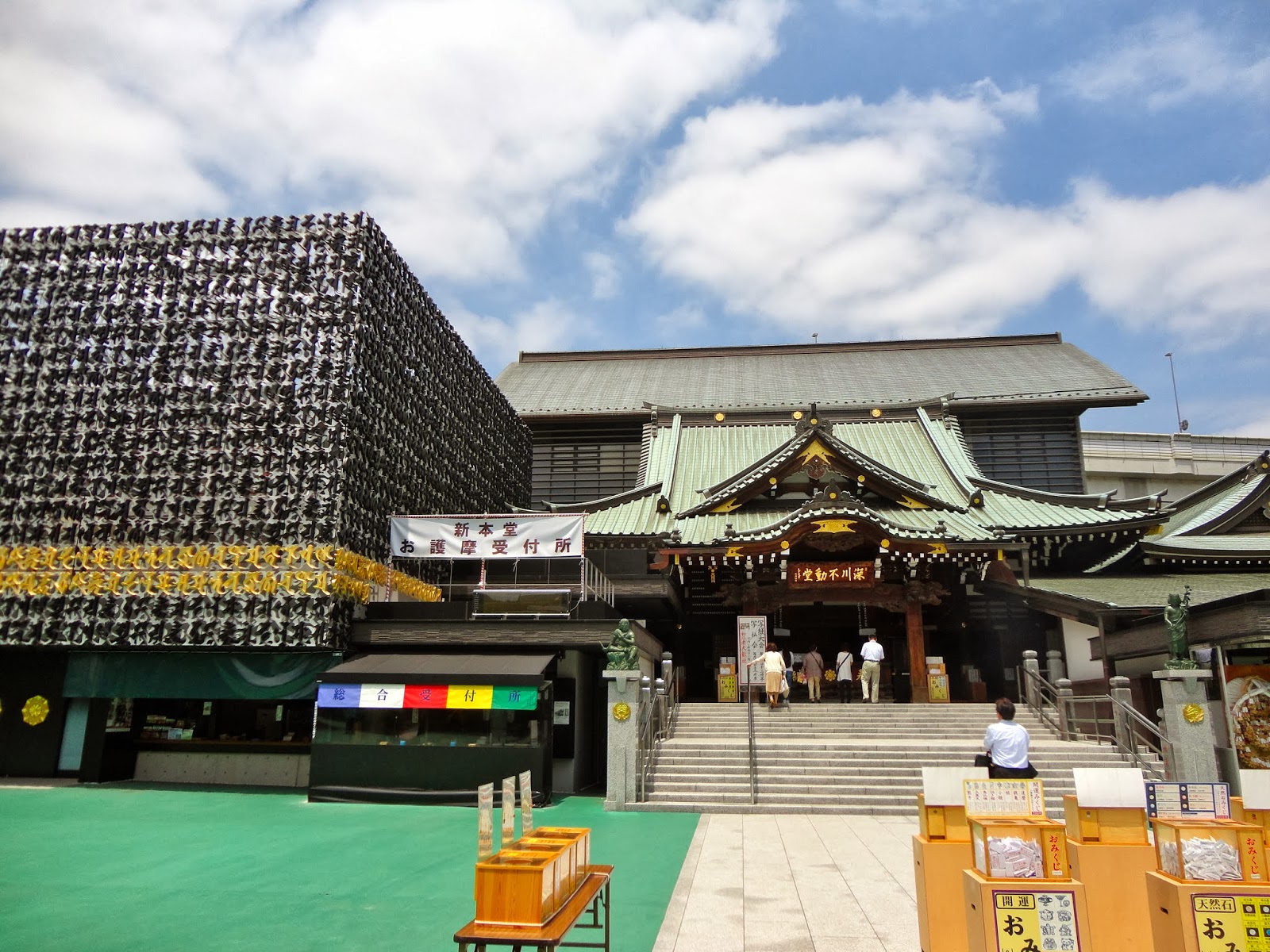
The old main hall of the temple is still the main entrance

Fukagawa Fudodo is not an independent temple; it belongs to Naritasan Shinshoji, which is maybe 60 kilometers away, near Narita airport.  (By the way, if you have a long layover at Narita airport, a visit to Naritasan Shinshoji might be just the thing.)  The main deity of Shinshoji is Fudo Myo O, the unmoving brilliant king.  One time, the temple sent a statue of Fudo to Edo (now known as Tokyo), and it attracted lots of followers there as well.  Finally, in 1881, the Fudodo or Hall of Fudo was constructed in Fukagawa, Tokyo.  The hall burned twice--in the great earthquake of 1923 and again in WWII.  However, the statue was moved to safety.  The old main hall, rebuilt sometime after the war, is a very traditional hand-built temple with a tatami floor.  The goma fire ceremonies at the Fudodo attracted many worshippers.  The first time I visited this temple, there was a goma ceremony under way, with everyone sitting on the tatami floor.  I just peeked inside, I was too shy to go in.  However, just the sounds of the chanting and the large taiko drum were impressive, even from outside.  At that time, a new main hall was under construction.  It was finished a few years ago, adding much room and something like 'stadium seating' to the space where the goma ceremony is held.

The new main hall is the rectangular building to the left
  The original Fudo statue is enshrined in the new space, while the old main hall was preserved, with the addition of a new, large-scale statue of Fudo.  You can still admire the traditional carpentry of the old main hall--decades worth of smoke and soot have been removed, although the texture of the wood has been highlighted where the soot has penetrated.  The new giant statue is also impressive.  The new main hall is to the left of the old one.  From an architectural standpoint, the new main hall is merely a rectangular building, nothing temple-ish about the structure on the outside.  What is remarkable is that the exterior is covered with a kind of screen made of Sanskrit letters, or bonji.  The letters spell out the mantra of Fudo, although they look like some complicated design to the unenlightened viewer.
These Sanskrit letters spell the mantra of Fudo Myo O, which is chanted during the fire ceremony
Traditional carpentry was used on this mid-20th century rebuild of the old main hall
You are asked to remove footwear before entering, and to carry them with you in a plastic bag.  The interior is now carpeted (although the old main hall still has tatami).  The goma ceremonial space is rather lofty, with the famous statue of Fudo (which is not really very big) high up on the wall.  There are elaborate canopies of gold hanging decorations--these are among the traditional features of the otherwise very modernistic hall.  The new hall is kept rather dark and dramatic--this may be to recreate the atmosphere of old ceremonial halls, which tend to be black with smoke.  As you approach the new ceremonial space, you discover four or five spacious tiers of benches.  There is also a tatami area just in front of the altar area, which could be used by those who want to sit on the floor Japanese style.  Actually, those tatamis are black, contributing to the brooding darkness.  There are four or five ceremonies every day, so you don't have to worry too much about the timing.  You can inscribe special prayer sticks to be burned in the ceremony, although I never have.  The ceremony starts with a clangorous large bell, calling the congregants.  Then, a small handbell is rung as the chief priest and assistants enter in procession.  Some of the assistants are blowing shell trumpets as they walk.  Once the chief priest is seated in front of the altar, there are some preliminary prayers and dedications (these can also be requested by anyone).  Then, the four huge taiko drums are sounded for the start of the fire ceremony.  These drums actually cause the floor to vibrate.  The priest does all his esoteric moves as the fire is built up.  A lay assistant brings sacred tablets to be purified by passing them above the flames.  (These tablets are also available on request--they are not burned, so I suppose you take them home.)  The drums sound along with the rhythm of the sutra chanting.  At a certain point, the lay assistant invites the congregants to bring personal objects like handbags to be passed above the flames.  Remarkably, even with all the chanting and ritual, the ceremony ends after about 30 minutes, as the last embers die away on the altar.  If you stick around, you might see the monks come in with vacuum cleaners and brooms to prepare for the next ceremony.  
A Shinto shrine to Inari-sama is on the temple grounds

The fox is the tutelary animal of Inari-sama


There is still much to see here after the ceremony.  There is a 'corridor of prayer' that runs under the main altar, so you can feel the power of the Fudo image above you.  The passage is lined with prayer beads and maybe some 1000s of Fudo statues.  In the next building, also a new construction, there are many more altars and statues of Fudo and other deities.  If you go up to the fourth floor, you can admire a huge ceiling painting of Dai Nichi Nyorai, the Cosmic Buddha.  Some of these areas are nearly empty much of the time, and it should be possible to find a quiet spot for a few minutes of meditation seated on the tatami.  Outside, there is a 'Shinto' shrine dedicated to Inari.  There is also a shrine to the dragon gods, spouting water, where you can float a written prayer in the water.  There is also a spot where you can have your car blessed for protection against accidents--this seems to be a specialty of certain Shingon temples.  There are pavilions where you can buy amulets and sutra books and other kinds of souvenirs.  There is a desk for temple stamp inscriptions, and a special altar to return amulets and such that are worn out.  The temple has one or two kinds of incense on sale, but there is also a Buddhist goods shop in front of the temple that has a reasonable selection of incense.  
Shrine of the Dragon God

Ringing the bell symbolizes realization of your wish
Fukagawa Fudo is located in the part of Tokyo called Shitamachi, or downtown, a flat area, partly land reclaimed from Tokyo Bay.  It was the center of middle-class culture in the old days--there is still a geisha district here.  So there are many traditional shops selling sweets, crackers and other snacks.  There is a large modern art museum, a museum of traditional culture, a famous samurai garden (Kiyosumi Koen) and other temples, so a visitor could easily spend half a day or more in this area. As special as these cultural attractions are, I am sure the locals are very appreciative of having the Fudoson in their neighborhood.  

Tuesday, September 24, 2013

Memorable temples--Gokokuji

The temple Gokokuji
The Niomon (gate with two guardian figures)


I first visited Gokokuji (mountain name: Shinreizan) six or eight years ago.  I was just finding out about esoteric Buddhism (called mikkyo in Japanese) and I didn't know there was esoteric Buddhism in Japan.  But there was a Tibet festival at the temple, so I went for a look.  There was an outdoor goma, or fire ceremony, conducted by the leader of the visiting Tibetan group.  There was a sand mandala, which I saw being created.  For the occasion, the temple opened the main altar, which is normally kept closed.  The image inside the altar is an example of a hibutsu, an image that is not normally shown to the public.  Well, I thought it might be cool to see something that is not normally shown to the public, so I went into the main hall.  However, my memories of that visit are pretty vague--I think I was still influenced by my experiences in a very exclusivist Nichiren-based organization that discouraged visiting temples of other sects.  The image in the altar is Nyoirin Kannon, which I had never heard of at that time.  However, I remember that the statue was rather dynamic, with head tilted, seated with one knee up, a rather sensuous pose compared to most Buddha statues.   

The main hall, Kannon-do, dedicated to Nyoirin Kannon

This hall is nearly intact from the 17th century


I recently visited the temple again, finding out a lot more interesting information.  The temple was founded in 1681 and the main hall is pretty much as it was when originally constructed in 1697.  It was founded by Keshoin, who was the mother of the shogun Tokugawa Tsunayoshi.  Keshoin dedicated the temple to the memory of her deceased son.  The interior of the hall is richly decorated, although much of it is darkened by time as well as the smoke from incense and candles.  Nyoirin Kannon is a form of Kannon that embodies both motherly love and invincible power against negativity.  There are around 33 different forms of the Bodhisattva Kannon--the 1000-arm one is well-known, the 11-headed one is very common, but Nyoirin Kannon is a bit unusual, in my experience.  

Two views of the esoteric Treasure Tower


I took my temple stamp album into the main hall.  The monk in charge did the calligraphy while I looked around the main hall.  There are lots of very old statues, and there was also a modern-looking oil painting of Kannon riding on a dragon.  After giving me the temple stamp, the monk told me a few things about the temple's history.  There is a group of statues on either side of the main altar, which the monk explained, are all the forms of Kannon.  These statues were commissioned by Keshoin after the death of her son, when she signaled the end of her worldly life by cutting her hair.  Some of her hair was put inside each of the statues.  These were dedicated in the hope that her son would soon reach enlightenment.  Motherly love!

The gate of 'no aging'

A guardian figure


Other notable features of the temple include the treasure tower (29th c.) and a guest reception house that was moved from the famous temple Miidera in Shiga Prefecture. Also, there is a gate with the inscription 'Fu Ro' meaning 'no old age.'  The inscription is in the handwriting of the shogun Ietatsu.  The temple is easy to find; there is a subway station named Gokokuji, and the relevant exit brings you out right in front of the Nio Gate.  Also, the altar of Nyoirin Kannon is opened on the 18th of every month.  The altar is opened during the sutra recitation starting at 9:00 AM, open to the public.  A free brochure has information about the temple in English

A leaping 'shishi' on the base of a large lantern

This gate is in the style of a samurai estate rather than a temple


Guest house from the temple Miidera


Tuesday, January 8, 2013

From Darkness into Light

Temples dedicated to Amida use gold to make a strong impression of light

Temple Darkness Experience
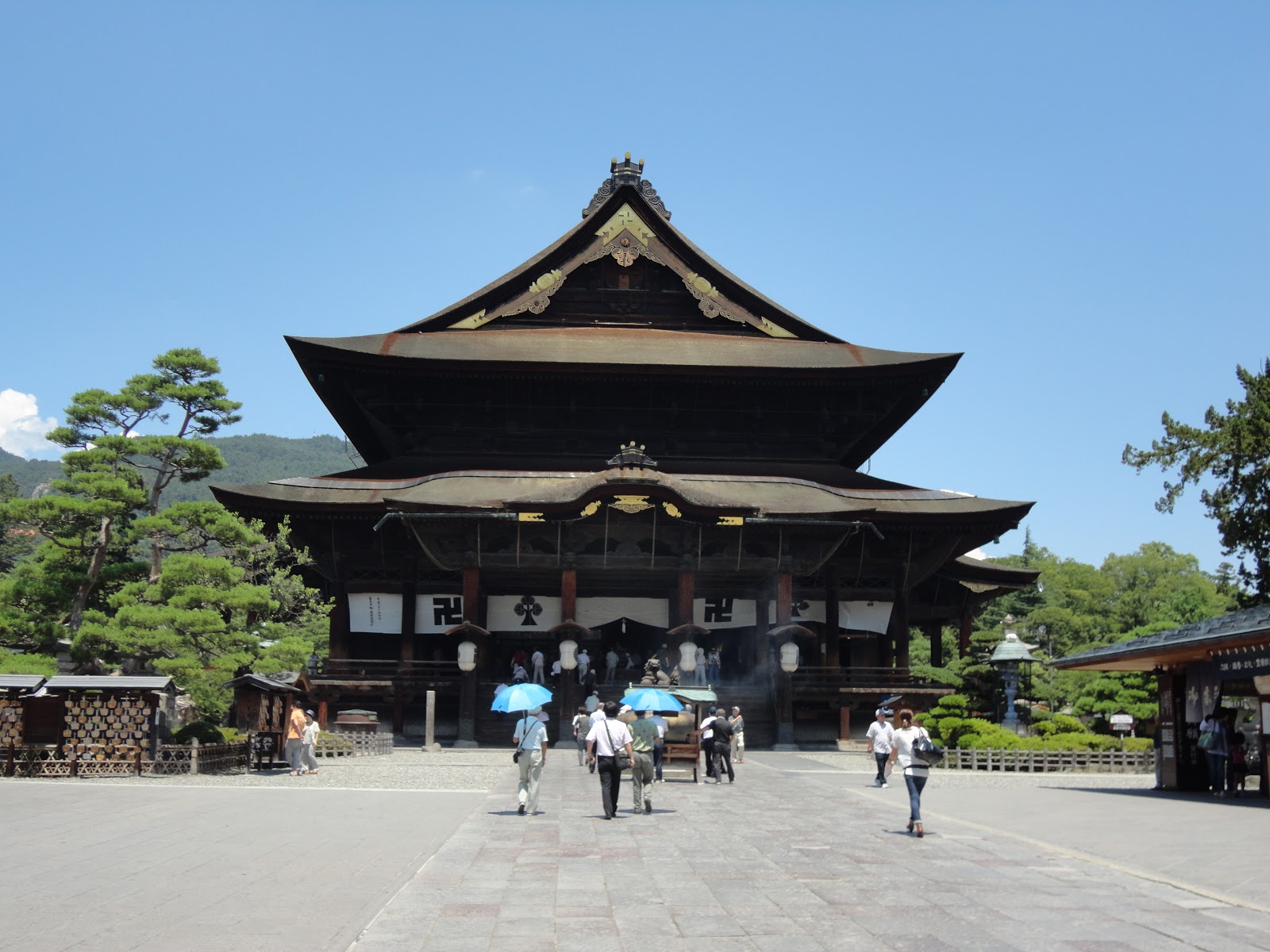
  1. Light is a basic metaphor of Buddhism--the whole thing is to find en-LIGHT-enment, right?  To stimulate people to think a bit about enlightenment, some temples offer a darkness experience, which can give you a refreshed view of light.  The temple Zenkoji in Nagano City has a famous darkness experience.  Inside the main hall of the temple, there is a staircase going down into a completely dark hallway.  At the bottom of the stairs, you put your right hand against the wall and proceed, unseeing, into the darkness.  After going around a corner or two, your hand will encounter a traditional Japanese lock holding something closed.  This means that you are directly under the statue of Amida Buddha (a Buddha of light) in the main altar.  You can rattle this lock and pull on it as a sign of your desire to go to the Pure Land of Amida.  The darkness symbolizes ignorance and death, while the Pure Land is a kind of heaven which you can reach after death by believing in Amida.  So this act is a kind of rehearsal or simulation of death.  But you are really still alive, so you can proceed onward, finally reaching another stairway up to the main hall.  Near the top of the stairway is a large mirror, allowing you to see your 'reborn' self for the first time. 


The main hall of Zenkoji
Temple stamps can be obtained when making a donation.  This one shows Amida.
The Pure Land school of Buddhism is widespread in Japan, although Zenkoji was founded without affiliation to any particular sect.  Nowadays, ceremonies are conducted by priests of both Pure Land and Tendai traditions.  The Amida statue at Zenkoji is a 'hibutsu,' or secret Buddha, that is never exposed to view.  There is no explicit reason for this, but one can imagine it is to stimulate the desire to meet Amida.

Gyokushin Mitsuin
Near the southwestern edge of Tokyo is the temple Gyokushin Mitsuin, commonly known as Tamagawa Daishi.  The Daishi, or Great Master, in this case, is Kobo Daishi, who studied Vajrayana Buddhism in China and established Shingon Vajrayana Buddhism in Japan.  This temple seems rather unassuming--the roofline is not especially high, and the grounds are not spacious.  There is a small garden with several stone Buddhas and several gongs and bells that can be rung, using the sense of hearing as a drive to enlightenment. 
Kongosho, a ritual implement

You can enter the main hall to approach the altar of Kobo Daishi. The priest is very likely to offer greetings and a short chat (in Japanese) if you are interested. Here there is also a stairway down to a world of darkness. The priest recommends repeating 'Namu Daishi Henjo Kongo' as you descend into the darkness. Again, you use your right hand on the wall as you proceed. Soon, you will find a kongosho or vajra ritual implement in a niche in the wall. You can hold onto it, visualizing its power of protection. As you continue, the path curves around, while there are also upward and downward slopes. Finally, you emerge into the brightly illuminated Henjo Kongo Den, a cave-like temple with hundreds of stone Buddhas of various sizes. Among them, Dainichi Nyorai (the Cosmic Buddha, also a Buddha of light) and Kobo Daishi are prominent. There are also 88 statues that allow you to replicate the pilgrimage to 88 temples of Shikoku Island. Another suggestion of the priest is to find the number among the 88 that corresponds to your age, and make a wish (I guess if you are 89 or older, you start again from no. 1). There are statues of Avalokitesvara/Kuan Yin and many other Buddhas. There are twelve Buddhas that correspond to the 12 animals of the Chinese zodiac, allowing you to find your personal Buddha based on your birth year. Finally, as you leave, there is a large gong which you can ring to announce the successful completion of your mini-pilgrimage. I bought a nice representation of a kongosho that you can attach to a phone or handbag as a reminder of the pilgrimage, and a copy of the Heart Sutra that is small enough to be used in the same way.
  

Amida Buddha