Quiet tea, talky tea

Butsuma--a space for the Buddha. Chanoma--a space where people drink tea, eat, chat.
Showing posts with label Shingon. Show all posts

Thursday, October 10, 2013

Fukagawa Fudo--memorable temples

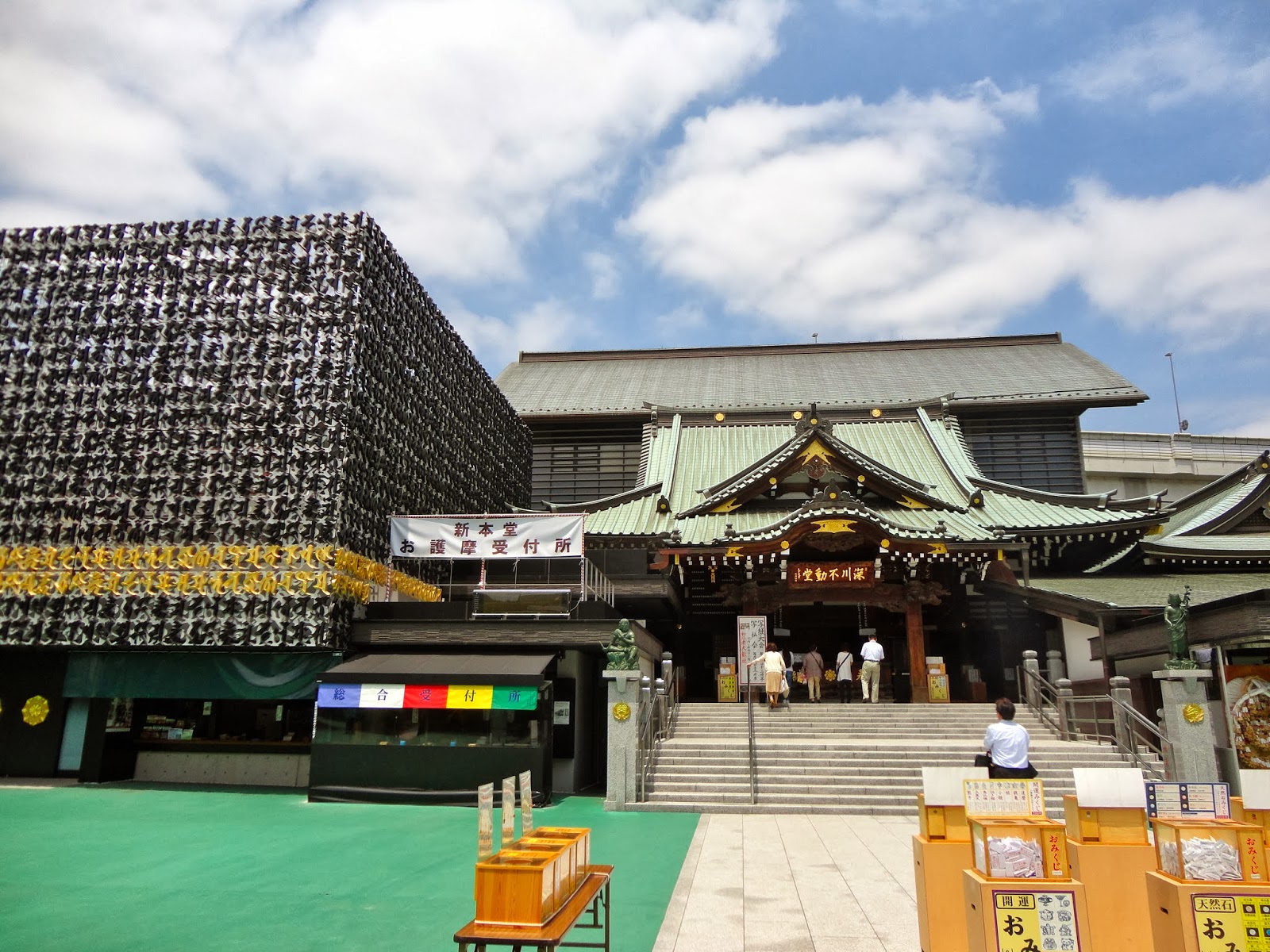
The old main hall of the temple is still the main entrance

Fukagawa Fudodo is not an independent temple; it belongs to Naritasan Shinshoji, which is maybe 60 kilometers away, near Narita airport.  (By the way, if you have a long layover at Narita airport, a visit to Naritasan Shinshoji might be just the thing.)  The main deity of Shinshoji is Fudo Myo O, the unmoving brilliant king.  One time, the temple sent a statue of Fudo to Edo (now known as Tokyo), and it attracted lots of followers there as well.  Finally, in 1881, the Fudodo or Hall of Fudo was constructed in Fukagawa, Tokyo.  The hall burned twice--in the great earthquake of 1923 and again in WWII.  However, the statue was moved to safety.  The old main hall, rebuilt sometime after the war, is a very traditional hand-built temple with a tatami floor.  The goma fire ceremonies at the Fudodo attracted many worshippers.  The first time I visited this temple, there was a goma ceremony under way, with everyone sitting on the tatami floor.  I just peeked inside, I was too shy to go in.  However, just the sounds of the chanting and the large taiko drum were impressive, even from outside.  At that time, a new main hall was under construction.  It was finished a few years ago, adding much room and something like 'stadium seating' to the space where the goma ceremony is held.

The new main hall is the rectangular building to the left
  The original Fudo statue is enshrined in the new space, while the old main hall was preserved, with the addition of a new, large-scale statue of Fudo.  You can still admire the traditional carpentry of the old main hall--decades worth of smoke and soot have been removed, although the texture of the wood has been highlighted where the soot has penetrated.  The new giant statue is also impressive.  The new main hall is to the left of the old one.  From an architectural standpoint, the new main hall is merely a rectangular building, nothing temple-ish about the structure on the outside.  What is remarkable is that the exterior is covered with a kind of screen made of Sanskrit letters, or bonji.  The letters spell out the mantra of Fudo, although they look like some complicated design to the unenlightened viewer.
These Sanskrit letters spell the mantra of Fudo Myo O, which is chanted during the fire ceremony
Traditional carpentry was used on this mid-20th century rebuild of the old main hall
You are asked to remove footwear before entering, and to carry them with you in a plastic bag.  The interior is now carpeted (although the old main hall still has tatami).  The goma ceremonial space is rather lofty, with the famous statue of Fudo (which is not really very big) high up on the wall.  There are elaborate canopies of gold hanging decorations--these are among the traditional features of the otherwise very modernistic hall.  The new hall is kept rather dark and dramatic--this may be to recreate the atmosphere of old ceremonial halls, which tend to be black with smoke.  As you approach the new ceremonial space, you discover four or five spacious tiers of benches.  There is also a tatami area just in front of the altar area, which could be used by those who want to sit on the floor Japanese style.  Actually, those tatamis are black, contributing to the brooding darkness.  There are four or five ceremonies every day, so you don't have to worry too much about the timing.  You can inscribe special prayer sticks to be burned in the ceremony, although I never have.  The ceremony starts with a clangorous large bell, calling the congregants.  Then, a small handbell is rung as the chief priest and assistants enter in procession.  Some of the assistants are blowing shell trumpets as they walk.  Once the chief priest is seated in front of the altar, there are some preliminary prayers and dedications (these can also be requested by anyone).  Then, the four huge taiko drums are sounded for the start of the fire ceremony.  These drums actually cause the floor to vibrate.  The priest does all his esoteric moves as the fire is built up.  A lay assistant brings sacred tablets to be purified by passing them above the flames.  (These tablets are also available on request--they are not burned, so I suppose you take them home.)  The drums sound along with the rhythm of the sutra chanting.  At a certain point, the lay assistant invites the congregants to bring personal objects like handbags to be passed above the flames.  Remarkably, even with all the chanting and ritual, the ceremony ends after about 30 minutes, as the last embers die away on the altar.  If you stick around, you might see the monks come in with vacuum cleaners and brooms to prepare for the next ceremony.  
A Shinto shrine to Inari-sama is on the temple grounds

The fox is the tutelary animal of Inari-sama


There is still much to see here after the ceremony.  There is a 'corridor of prayer' that runs under the main altar, so you can feel the power of the Fudo image above you.  The passage is lined with prayer beads and maybe some 1000s of Fudo statues.  In the next building, also a new construction, there are many more altars and statues of Fudo and other deities.  If you go up to the fourth floor, you can admire a huge ceiling painting of Dai Nichi Nyorai, the Cosmic Buddha.  Some of these areas are nearly empty much of the time, and it should be possible to find a quiet spot for a few minutes of meditation seated on the tatami.  Outside, there is a 'Shinto' shrine dedicated to Inari.  There is also a shrine to the dragon gods, spouting water, where you can float a written prayer in the water.  There is also a spot where you can have your car blessed for protection against accidents--this seems to be a specialty of certain Shingon temples.  There are pavilions where you can buy amulets and sutra books and other kinds of souvenirs.  There is a desk for temple stamp inscriptions, and a special altar to return amulets and such that are worn out.  The temple has one or two kinds of incense on sale, but there is also a Buddhist goods shop in front of the temple that has a reasonable selection of incense.  
Shrine of the Dragon God

Ringing the bell symbolizes realization of your wish
Fukagawa Fudo is located in the part of Tokyo called Shitamachi, or downtown, a flat area, partly land reclaimed from Tokyo Bay.  It was the center of middle-class culture in the old days--there is still a geisha district here.  So there are many traditional shops selling sweets, crackers and other snacks.  There is a large modern art museum, a museum of traditional culture, a famous samurai garden (Kiyosumi Koen) and other temples, so a visitor could easily spend half a day or more in this area. As special as these cultural attractions are, I am sure the locals are very appreciative of having the Fudoson in their neighborhood.  

Wednesday, July 25, 2012

Goma--Buddhist fire ceremony


Goma ceremony invokes power of Fudo Myo-o

Smells and bells

I have been interested in vajrayana (mikkyo, esoteric Buddhism) for a while.  Tibetan Buddhism is in this category.  The diaspora caused by conditions in Tibet has helped Tibetan Buddhism to spread around the world--it is now one of the better-known Buddhist traditions, I would say.  

In Japan, this tradition is represented by Shingon Buddhism.  Not quite the same as Tibetan, but some similarities.  A Japanese monk named Kukai (posthumously named Kobo Daishi, the Great Propagator of the Law) found an esoteric sutra in his independent studies.  Wanting to learn more about it, he managed to be appointed to a government legation to China, where he met a master of esoteric Buddhism.  He quickly learned the entire canon from his Chinese master, Huigo, and returned to Japan.  Shingon was actively supported by the government (believing that some 'magic' might help the country resist invasions and disasters.  He was granted the mountain now known as Koyasan to establish a monastery--the mountain is still a center of Shingon Buddhism today.

The Goma fire ceremony is one esoteric ceremony that is relatively easy to see.  It is dedicated to Fudo Myo-o, whose name means Unmoving Brilliant King.  Any temple that has an image of Fudo probably has or had a connection to mikkyo at one time--many of the major sects of Japanese Buddhism have been influenced by Shingon.   I have been trying to pay a bit more attention to Fudo these days, so I went to observe a couple of fire ceremonies.
This is a ritual implement for vajrayana ceremonies, although this is a very large one, probably not intended for actual use.  Visitors can touch this one for good luck.

The rather unassuming Hall of Fudo Myo-o at the temple known as Takahata Fudoson

One famous temple for this is Takahata Fudoson (-son means object of worship, usually a statue or painting).  The official name is Takahatasan (the 'mountain name' of the temple, formed with the name of the place plus 'san' meaning mountain) Kongoji ( -ji means temple, Kongo is a central idiom of mikkyo that has connotations of adamantine, unbreakable power).  The impression of power is evident in images of Fudo as well as in the ceremony.  The temple was founded more than 1000 years ago.  The Fudo-do or Hall of Fudo is several hundred years old.  They conduct the Goma ceremony there several times every day.  The Fudo-do is not large, but its ceiling and interior walls are dark with smoke.  Clearly the only lighting in the original design was candles; now there are a couple of floodlights illuminating the central space, but their brightness cannot completely overcome the gloom.  

A railing separates the inner sanctum, with a typical square altar and large image of Fudo Myo-o and his attendants.  A small bell signals the entry of the priests, with the officiant sitting directly in front of the altar.  The officiant carries out several ritual duties including flinging very small drops of water about with a wand.  The priests begin to chant, and soon the officiant lights the fire, made of stacked pieces of wood, anointed with various oils and spices.  As the flames mount, the voices become stronger and the large bass drum is sounded.  This large sound invokes the invincible power of Fudo.  The priests chant some sutras and then for an extended period, the mantra of Fudo.  Several lay people join in chanting the mantra.  Then, as the chanting and drumming continue, a priest invites the lay people to approach the altar of Fudo, which is done in an orderly single file.  The ceremony continues, with various tablets being exposed to the purifying flames, sometimes getting a bit singed.  As the lay people return to their places in the outer area, the fire is beginning to die down.  After the last bits of the fire are seen to, the officiant bows to the group of lay people and the line of priests withdraws, again to the sound of a small bell.

Tuesday, January 3, 2012


New Year Celebration III


On January 3, I went to the Koyasan Tokyo Betsuin, the Tokyo branch temple of Koyasan Shingon esoteric Buddhism. They have had ceremonies at 10:00 AM and 2:00 PM for the past three days. So I dropped into the 2:00 ceremony today, to see the goma ceremony, when a fire is built in a special altar to invoke the power of Fudo Myo O, the unmoveable god of light, also known as Acala. The temple has a hard floor with chairs and a tatami area closer to the altar. As I was sitting in a chair waiting, a priest came out and invited everyone to move up to the tatami area. I thought maybe I could see better from there, so I moved.


Before the start of the ceremony, a very loud bell was rung as a signal. Then, a procession of four priest moved into the temple, with the first priest ringing a hand-held bell. Three of the priests were wearing the usual Shingon-style kesa, but one was wearing a brown robe that looked similar to robes that southeast Asian monks wear. The chief priest sat at a square altar right in front of the statue of Kukai Kobo Daishi. There was another square altar just behind that. The extra altar had a kind of canopy over it, and this is where the fire was built. I don't know if the canopy was a ritual necessity or maybe a way to control the smoke. Another priest hit a large drum and the fourth priest rang the large bell. Actually, several bells of various sizes were rung during the ceremony. After some invocational prayers, one priest took a microphone to encourage everyone to join in reciting the Heart Sutra. We recited it three times--I didn't know it was ever recited more than once. As the flames grew higher, one of the priests invited us to make incense offerings, noting that we might want to think of any special wishes or prayers while making the offering. Then, we started reciting the mantra of Fudo Myo O. That went on for a while, with the pace gradually speeding up until it was pretty frenzied, accompanied by the large drum. Then there was another mantra, one I couldn't identify, and another one that sounded like the mantra of Shakyamuni, but different from the one I know. All through this, the priests were passing ritual tablets through the flames and also adding more materials to the fire. Then, we were invited to join in the Gohogo, the invocation of Kobo Daishi. The ceremony ended after a few more prayers, and then the priests recessed, again led with a hand bell. Finally, they brought out the tablets that had been passed through the flames to present them to believers who had made special offerings.


There were three or four large casks of sake off to one side, with ladles and paper cups. I was hoping...but for some reason, they didn't offer me any! I don't know who got to drink that. But it certainly was a satisfying ceremony. I will see if I get my wish!

Tuesday, November 15, 2011

Don't discuss Buddhism!


I am facing the possibility of a return to the US. I have enjoyed the overall Buddhist-friendly environment in Japan, and I wonder what it will be like in the US. My current impressions of Buddhism in the US (or the 'west' in general) are pretty much from the interwebs. But here it is: English speakers on the internet like lengthy harangues about what they understand Buddhism to be. I'm not saying no one gets it right...I can't make that kind of judgement. But among the Buddhist practitioners I know here, no one gets into too much theory. Of course, if you want to know about emptiness, non-self, the Five Aggregates--well, just ask Google-san. There may in fact be some Japanese who talk about such things. But I have met very few. In the two meditation groups I hang out with, the approach is to recite a few traditional prayers and the Heart Sutra, either before, after or bracketing the meditation. Of course, there are some physical exercises, too. In the meditation class at the Shingon temple, everyone learns three of the mudras or hand positions. These (AFAIK) have very explicit meanings and functions in Shingon--part of the esotericism, generally not taught to lay people. These three mudras are not hidden from casual practitioners, but at the same time, there is not much discussion of them. The Shingon session also includes two mantras--the teacher gives a very quick and maybe vague summary of the meaning or intention of these. After the sessions (both the Shingon one and the zazen at a Tendai temple) everyone is invited for tea and cookies (actually sembei) afterward, with opportunities for questions. But, NO ONE EVER ASKS ANYTHING! Why do we have to hold our hands that way? What is the meaning of the mantras? No one ever asks. Why not? A lot of it is probably Japanese upbringing and etiquette. Questions have a tinge of challenge to authority. They suggest that the teacher maybe didn't do his job well enough. The Heart Sutra is so well-known, it is like the elephant in the room. No one discusses it. I would guess most people don't feel any necessity for understanding the sutra on an intellectual level, so just reciting in the context of a meditation session is enough. Maybe it will just soak in. Actually, I find this admirable.


My impression is that some westerners, especially of the Zen persuasion, are reluctant to do sutra recitations or anything ceremonial. Just sitting should be enough. Maybe they are right. But the Japanese don't even think twice about ceremonies--they happen all the time, everywhere, not just in religious contexts. I would guess that 95% of Japanese who visit a temple will drop a coin in the box and put their hands together in front of the temple or image. If everyone around them is reciting a sutra, they will do it too. Personally, I like this idea that the sutra will soak in (to some extent) just by reciting it. So, questions are not really necessary. Certainly it keeps the vibes very mellow. No contradicting, no 'yes, but...'. Very often, even a sermon (howa 法話)will be very mundane. The priest at the Tendai temple often uses anecdotes about the children in the temple kindergarten in his mini-howa before the meditation session.


I suspect that many westerners are uncertain about meditation, whether they are doin' it rite. So they like to ask a lot of questions. Why am I so fidgety? How can I control the monkey mind? And so on. On the other hand, most Japanese have had at least some exposure to meditation from an early age. Kids who go for karate or other martial arts usually start and end their practice sessions with a minute or two of silence. As people grow up, they realize that no matter how much you want to fidget, you shouldn't. Partly a matter of respect for those around you. Also, 90% (I don't really know, but it is a lot) of Tokyo people ride public transport. I can't really sleep deeply on an urban train making a lot of stops, but I stay in a meditative state for long stretches. Probably lots of other people do, a kind of non-religious meditation. As I age, I feel the necessity to geeze a bit, so I have to wonder about the next generation, even in Japan. I heard one aspiring meditator complain that after settling down for meditation, pop songs kept running through his head. Get those buds out of your ears, people!!


So, maybe I will find a group in the US that uses recitation and silence more than theoretical discussions. If you know any, let me know! (The pic at the top is my basic meditation set--incense and a candle help set the mood.)