Quiet tea, talky tea

Butsuma--a space for the Buddha. Chanoma--a space where people drink tea, eat, chat.

Tuesday, January 8, 2013

From Darkness into Light

Temples dedicated to Amida use gold to make a strong impression of light

Temple Darkness Experience
  1. Light is a basic metaphor of Buddhism--the whole thing is to find en-LIGHT-enment, right?  To stimulate people to think a bit about enlightenment, some temples offer a darkness experience, which can give you a refreshed view of light.  The temple Zenkoji in Nagano City has a famous darkness experience.  Inside the main hall of the temple, there is a staircase going down into a completely dark hallway.  At the bottom of the stairs, you put your right hand against the wall and proceed, unseeing, into the darkness.  After going around a corner or two, your hand will encounter a traditional Japanese lock holding something closed.  This means that you are directly under the statue of Amida Buddha (a Buddha of light) in the main altar.  You can rattle this lock and pull on it as a sign of your desire to go to the Pure Land of Amida.  The darkness symbolizes ignorance and death, while the Pure Land is a kind of heaven which you can reach after death by believing in Amida.  So this act is a kind of rehearsal or simulation of death.  But you are really still alive, so you can proceed onward, finally reaching another stairway up to the main hall.  Near the top of the stairway is a large mirror, allowing you to see your 'reborn' self for the first time. 
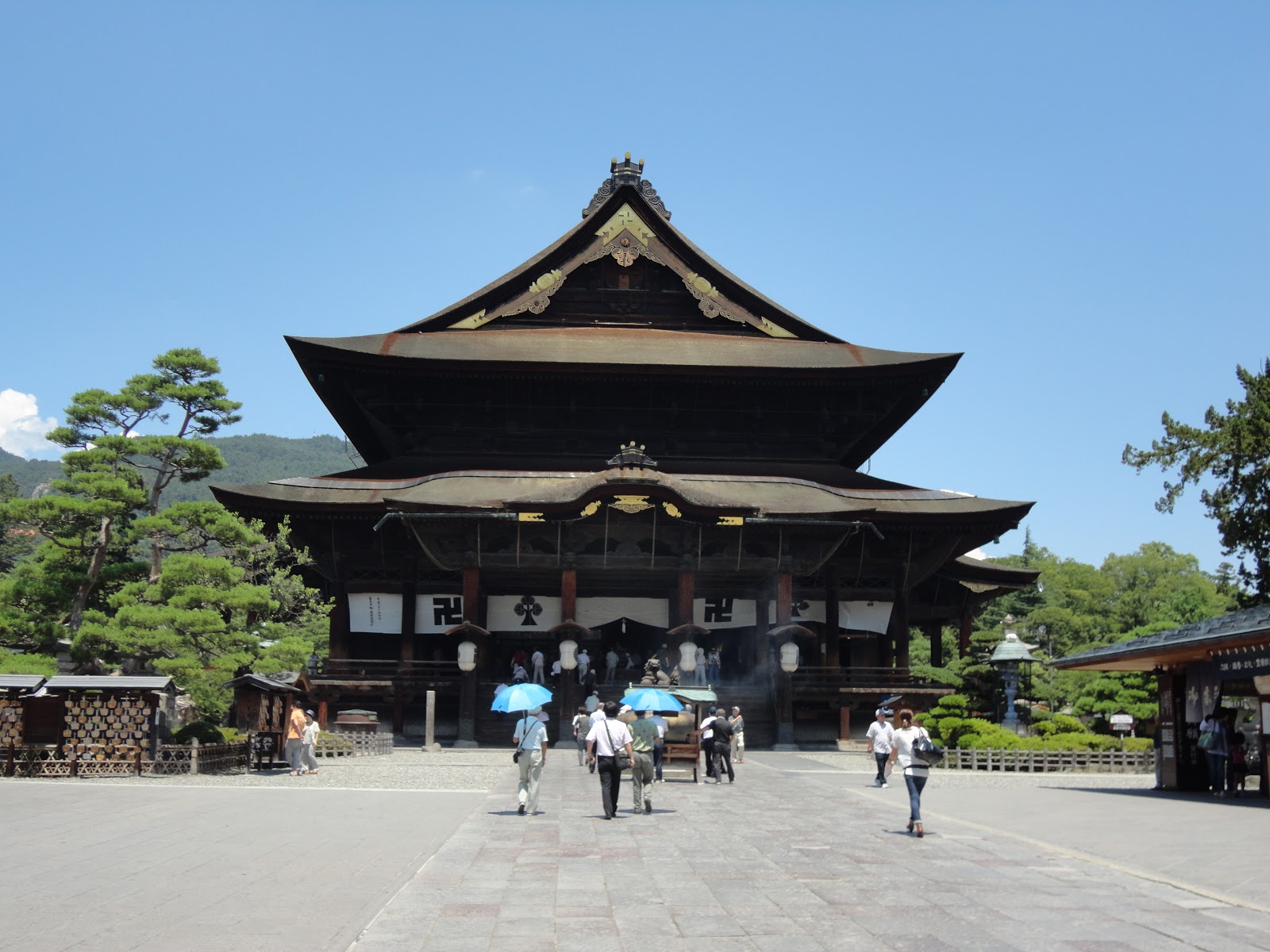

The main hall of Zenkoji
Temple stamps can be obtained when making a donation.  This one shows Amida.
The Pure Land school of Buddhism is widespread in Japan, although Zenkoji was founded without affiliation to any particular sect.  Nowadays, ceremonies are conducted by priests of both Pure Land and Tendai traditions.  The Amida statue at Zenkoji is a 'hibutsu,' or secret Buddha, that is never exposed to view.  There is no explicit reason for this, but one can imagine it is to stimulate the desire to meet Amida.

Gyokushin Mitsuin
Near the southwestern edge of Tokyo is the temple Gyokushin Mitsuin, commonly known as Tamagawa Daishi.  The Daishi, or Great Master, in this case, is Kobo Daishi, who studied Vajrayana Buddhism in China and established Shingon Vajrayana Buddhism in Japan.  This temple seems rather unassuming--the roofline is not especially high, and the grounds are not spacious.  There is a small garden with several stone Buddhas and several gongs and bells that can be rung, using the sense of hearing as a drive to enlightenment. 
Kongosho, a ritual implement

You can enter the main hall to approach the altar of Kobo Daishi. The priest is very likely to offer greetings and a short chat (in Japanese) if you are interested. Here there is also a stairway down to a world of darkness. The priest recommends repeating 'Namu Daishi Henjo Kongo' as you descend into the darkness. Again, you use your right hand on the wall as you proceed. Soon, you will find a kongosho or vajra ritual implement in a niche in the wall. You can hold onto it, visualizing its power of protection. As you continue, the path curves around, while there are also upward and downward slopes. Finally, you emerge into the brightly illuminated Henjo Kongo Den, a cave-like temple with hundreds of stone Buddhas of various sizes. Among them, Dainichi Nyorai (the Cosmic Buddha, also a Buddha of light) and Kobo Daishi are prominent. There are also 88 statues that allow you to replicate the pilgrimage to 88 temples of Shikoku Island. Another suggestion of the priest is to find the number among the 88 that corresponds to your age, and make a wish (I guess if you are 89 or older, you start again from no. 1). There are statues of Avalokitesvara/Kuan Yin and many other Buddhas. There are twelve Buddhas that correspond to the 12 animals of the Chinese zodiac, allowing you to find your personal Buddha based on your birth year. Finally, as you leave, there is a large gong which you can ring to announce the successful completion of your mini-pilgrimage. I bought a nice representation of a kongosho that you can attach to a phone or handbag as a reminder of the pilgrimage, and a copy of the Heart Sutra that is small enough to be used in the same way.
  

Amida Buddha

Friday, October 19, 2012

Kimono experience

Costume from the Kabuki dance, Wisteria Maiden


A friend asked me to help out at a kimono experience that was expected to attract a lot of foreigners.  There were several events in Nihonbashi, the center of Tokyo, that coincided with the IMF meeting in Tokyo.  The event I went to had two parts: an exhibition of Kabuki costumes and a kimono-wearing experience.  

The costume exhibition was combined with two lectures (in Japanese) about costumes.  There was no attempt to provide English translations, but for the exhibit, there were English handouts of the character and play associated with each costume, as well as a bit about the materials and style of the costume.  An expert from a major Kabuki production company came to give a lecture (which required a paid ticket) which I did not attend.  However, after the formal part of the lecture, the expert went to the exhibition room and made some remarks about the costumes.  Perhaps the most impressive comment was that one of the costumes would cost 'nan-zen man' in yen to recreate.  'Nan-zen man' translates to 'hundreds of thousands of dollars!'  This costume had huge hand-embroidered decorations on top of a heavy brocade robe.  Part of the problem is that there are not many artisans who still know these techniques.  This robe, plus the wig and sash to complete the costume, could weigh nearly 100 pounds.  There were three heavily embroidered robes that were worn by main characters.  There were also three kimonos worn by the 'maids' that had dramatic dyed patterns of phoenix feathers in bright, neon-like colors.  But the experts said these were 'plain' in comparison to the embroidered kimonos.


Kimonos and sashes


The kimono experience was run by Sasajima Sensei, a teacher of kimono wearing.  (Maybe you didn't know there were teachers of kimono wearing.)  For no charge, visitors could select a kimono and sash and other accessories.  Then, a flock of able assistants would flutter around, helping in the process of layering of robes, tying of various cords and sashes, and adjusting every fold to perfection.  For women, there were the trailing sleeves usually worn by younger women as the flashiest fashion, as well as the shorter-sleeve version worn by others.  These were in beautiful brocades, hand-dyed, some were hand painted, some woven with gold thread, with patterns ranging from flowers and seasonal themes to abstract patterns.  For men, the only choice was the black kimono worn with hakama trousers for a formal occasion like a wedding.  I am pretty sure these were all genuine silk, so the prices for these outfits would certainly be in the 1000s of dollars, many of them more than 10,000.  Once all the fussing was over, the visitors could stroll around the lobby and have photos taken in front of a gold screen and red umbrella.  One visitor wore her kimono to an IMF meeting, and some were able to enjoy rickshaw rides (another part of the series of events) showing off their finery.

There were no cross-dressing requests, but some of the physical types presented a bit of a challenge.  A tall black woman--a body type similar to, say, Michele Obama--asked if pregnant women could do this (the obi sash is often pulled very tight for the most fashionable look).  Sasajima Sensei took on the challenge, with assurances that she could adjust everything to avoid obstetrical problems.  The visitor chose a light aquatic sky blue that presented a beautiful contrast with her ebony color.  Another challenge was a young girl who was about six or eight years old.  An adult kimono was tailored by a quick basting--no cutting-- that turned out very well.  

The event was available for three days.  The first day, there were only a few takers.  Then, word began to spread, and the numbers picked up.  On Saturday, the last day, the kimono ladies were rushing practically all day.  There were only three men who tried it, but probably 30 or 40 women.  It was a great opportunity to enjoy the high-quality artisanal experience that would normally require a considerable charge (for example, renting a kimono for a wedding or something). 
(Yamada-san admires a Kabuki costume while displaying her own fancy obi bow)

Thursday, September 13, 2012

Eating as a spiritual practice


Buddhist breakfast

'Itadakimasu'--the standard thing to say before eating in Japan.  What a phrase, what complex layers of meaning.  Itadaku is a humble verb meaning 'partake.'  Japanese has ways of speaking that reflect the humility of the speaker.  It seems remarkably consonant with one of the Six Verses for Training the Mind from the Tibetan Buddhist tradition: 'In any group, I will consider myself to be the lowest in rank.'  A fairly tough concept for most Americans (including me) to get their heads around.  The verb form itadakimasu is formal, suggesting respect for the food and those who prepared it.  So itadakimasu 'I humbly partake, with respect' is kind of like grace, but no god is involved--makes things so easy!  Probably 100% of school kids in Japan learn to say this at lunch.  No worries about religion in the lunchroom, who goes to what temple or church, or who believes or doesn't.  Just humility and respect.  

I went to a ceremony at the temple Sensoji this morning, starting at 7:00 AM, that involved about 30 minutes of chanting (the sutra of Avalokitesvara, = chapter 25 of the Lotus Sutra) in the main hall of the temple.  Then we moved to the Shoin, a traditional chamber in the garden of the former monastery Denboin.  There we did 'sai jiki,' which is a Buddhist way of eating.  The spiritual side is the point, much more than the nutritional side.  The food was about as simple as can be, okayu, which is rice cooked with extra water so that it is almost souplike.  Nothing is added, so the taste is just bland white rice.  By the way, this is a traditional breakfast in many parts of Asia, usually available at a hotel breakfast, for example.  Strongly salted side dishes are eaten with the gruel. Today's meal was typical--yellow takuan pickled radish, kelp boiled in sweet soy sauce, and gobo (a root vegetable) also cooked in a very salty way. But first, there was a ceremony, which I was struggling to read in Japanese.  First there was the invocation of the law, the Buddha and the sangha.  Then, we formed the meditation hand gesture to read affirmations of our respect for the food and  our hope for all sentient beings who hunger, both in the physical sense as well as the spiritual, both in this world and in worlds beyond this one.  A small plate was passed around, and each person added one bite of rice to the plate, as a symbolic offering.  This took five or ten minutes, and then finally we said 'Itadakimasu!'  Everyone ate silently, and finished rather quickly--for me, soupy rice takes a while to eat with chopsticks.  Then, tea kettles were passed around, and everyone filled the empty rice bowl with tea(or was it hot water?).  With one's last slice of radish, the inside of the bowl was wiped clean, and the tea was drunk, leaving the dishes clean.  Many monastics eat all their meals this way.  Next, there was a short sermon.  Afterwards, we took a spin around the garden.  

It is easy to apply an esoteric (mikkyo) Buddhist interpretation to this--actions of body, speech and mind are called mysteries, I think because of the effects they have.  This is karma.  Often, the link between cause and effect can be less than obvious--I don't suppose any homeless people actually had their hunger assuaged by our efforts.  But the idea is that the intention is what counts.  So we chanted and meditated for our minds.  We spoke our prayers and took action in the form of offering food and also eating in a humble and respectful way.  


The setting was probably a bit too luxurious.  The nineteenth-century building was lavishly detailed, decorated with beautiful hanging scrolls, and the entire side of the building facing the garden was completely open.  The group is a kind of club at the temple, and I was able to participate through an introduction by a friend.  

Here is the famous view of the Shoin with the pagoda of Sensoji in the background:

Thanks for reading!  (I think you can see a higher resolution if you click on the photo)

Sunday, July 29, 2012

Sounds of Goma


No videos allowed inside the hall, of course, so at Takahata Fudo, I took a short video just outside the entrance--live sound.

The sound is also broadcast around the temple grounds, so I took a video of the pagoda with the sound of the ceremony through loudspeakers.


Wednesday, July 25, 2012

Goma--Buddhist fire ceremony


Goma ceremony invokes power of Fudo Myo-o

Smells and bells

I have been interested in vajrayana (mikkyo, esoteric Buddhism) for a while.  Tibetan Buddhism is in this category.  The diaspora caused by conditions in Tibet has helped Tibetan Buddhism to spread around the world--it is now one of the better-known Buddhist traditions, I would say.  

In Japan, this tradition is represented by Shingon Buddhism.  Not quite the same as Tibetan, but some similarities.  A Japanese monk named Kukai (posthumously named Kobo Daishi, the Great Propagator of the Law) found an esoteric sutra in his independent studies.  Wanting to learn more about it, he managed to be appointed to a government legation to China, where he met a master of esoteric Buddhism.  He quickly learned the entire canon from his Chinese master, Huigo, and returned to Japan.  Shingon was actively supported by the government (believing that some 'magic' might help the country resist invasions and disasters.  He was granted the mountain now known as Koyasan to establish a monastery--the mountain is still a center of Shingon Buddhism today.

The Goma fire ceremony is one esoteric ceremony that is relatively easy to see.  It is dedicated to Fudo Myo-o, whose name means Unmoving Brilliant King.  Any temple that has an image of Fudo probably has or had a connection to mikkyo at one time--many of the major sects of Japanese Buddhism have been influenced by Shingon.   I have been trying to pay a bit more attention to Fudo these days, so I went to observe a couple of fire ceremonies.
This is a ritual implement for vajrayana ceremonies, although this is a very large one, probably not intended for actual use.  Visitors can touch this one for good luck.

The rather unassuming Hall of Fudo Myo-o at the temple known as Takahata Fudoson

One famous temple for this is Takahata Fudoson (-son means object of worship, usually a statue or painting).  The official name is Takahatasan (the 'mountain name' of the temple, formed with the name of the place plus 'san' meaning mountain) Kongoji ( -ji means temple, Kongo is a central idiom of mikkyo that has connotations of adamantine, unbreakable power).  The impression of power is evident in images of Fudo as well as in the ceremony.  The temple was founded more than 1000 years ago.  The Fudo-do or Hall of Fudo is several hundred years old.  They conduct the Goma ceremony there several times every day.  The Fudo-do is not large, but its ceiling and interior walls are dark with smoke.  Clearly the only lighting in the original design was candles; now there are a couple of floodlights illuminating the central space, but their brightness cannot completely overcome the gloom.  

A railing separates the inner sanctum, with a typical square altar and large image of Fudo Myo-o and his attendants.  A small bell signals the entry of the priests, with the officiant sitting directly in front of the altar.  The officiant carries out several ritual duties including flinging very small drops of water about with a wand.  The priests begin to chant, and soon the officiant lights the fire, made of stacked pieces of wood, anointed with various oils and spices.  As the flames mount, the voices become stronger and the large bass drum is sounded.  This large sound invokes the invincible power of Fudo.  The priests chant some sutras and then for an extended period, the mantra of Fudo.  Several lay people join in chanting the mantra.  Then, as the chanting and drumming continue, a priest invites the lay people to approach the altar of Fudo, which is done in an orderly single file.  The ceremony continues, with various tablets being exposed to the purifying flames, sometimes getting a bit singed.  As the lay people return to their places in the outer area, the fire is beginning to die down.  After the last bits of the fire are seen to, the officiant bows to the group of lay people and the line of priests withdraws, again to the sound of a small bell.

Saturday, May 19, 2012

Let's get wet!


Communal bathing in Japan

For most people in Japan, a quick shower is often just not good enough.  Gotta have a long, hot soak in a deep tub up to the neck.  This is pretty much the rule in Japan, where people have been enthusiastic bathers for many centuries.  In the early days, only the elite could actually afford bathing facilities, so public baths became well established.  Early on, the system was: wash thoroughly outside the tub, then enter the communal tub for soaking, warming and relaxing. 

I like getting clean as much as anyone else, but the idea of soaking with strangers doesn't appeal to most Americans.  When I first came to Japan, so many years ago, I rented a tiny room with no bath, so I had to make a daily trip to the local sento--public bath.  The first night I arrived, I was so tired, I just went right to bed.  The next day, I was ready to get clean, but going to the sento for the first time was pretty daunting.  A French guy living across the hall offered to go and show me the ropes.  

The first task is to choose the right entrance, for men or women.  Usually, these are notated with kanji--and I was completely at a loss.  However, Daniel showed me which one was the men's.  Before entering, you remove your shoes and put them in a shoe locker.  The building was a traditional one, with a high coffered ceiling.  This space was divided by a wall that was well over head height, although it did not go all the way to the ceiling.  There was an elevated desk, kind of like a pulpit, near the doorways, where one person could keep an eye on both the women's and men's areas.  This is also where you pay the entrance fee.  I was surprised to find a woman on duty there.  In the locker area, there was a block of lockers about chest height, so I was able to hide behind them while I took off my clothes.  Large sliding glass doors led into the bath area.  

As baths go, it was very nice.  The soaking tub was very large, the width of the room, with a contoured front.  Sentos are known for large murals on the back wall, above the soaking tub--this one had a view of Mt. Fuji, a very common subject for bath houses.  And, this establishment had large rocks/boulders worked into the tub, so you could lean against a warm rock to relax.  

But first, get clean.  There were rows of shower heads, but at waist height, intended to be used while sitting.  There were tiny stools and buckets.  Soap and shampoo were the bather's responsibility, although such supplies, as well as razors, pumice stones, washcloths and towels were on sale.  The shower rows also had mirrors, so you could shave sitting down under the shower.  So, I got all clean and headed for the tub.  

There is one bathing custom Daniel didn't tell me about.  Most Japanese people take a small towel, about the size of a US dish towel, into the bathing area.  It is used for washing, and then strategically deployed to the most crucial area(s) for modesty when moving around.  I didn't have such a towel with me, but I figured it was like the locker room in high school.  Only wusses worried about such things!  Okay, ready for the hot bath!

But it was really, really hot!  I noticed there was a thermometer on the wall that said 42 degrees C.  (Fahrenheiters, do the calculation!)  Anyway, hot enough to induce a strong blush to the skin.  So, I was sitting on the thick edge of the tub, legs in the hot water, facing the thermometer and looking up at the mural of Mt. Fuji.  I noticed a sliding door next to the thermometer, and I noticed it was sliding open.  There was the woman from the entrance desk!!  She pretended to be checking the temperature, but she took a certain amount of time directing her gaze to the thermometer, giving her plenty of time to check me out!  Well, a lot of Japanese are curious about such things, it's true.  I probably did not live up to her stereotype of westerners...sigh.  But I had my first experience of relaxed Japanese attitudes toward nudity--sometimes there is some mixing of the sexes, in varying degrees.  More about that later!

The photo shows a traditional style bath house--you may be able to see the craftsmanship in the construction.  This is called Akebono no Yu in the Asakusa area.  A cold drink from the machine is very refreshing after a hot dip.  This place is also notable for the extensive planting--is it wistaria?

Also, check here for photos of a typical bath house interior, complete with Mt Fuji on the back wall--in tile instead of paint.  You can also see the sit-down shower heads, each with its own mirror.  


This blog has good info on hot springs and sentos, even some about overseas destinations!  

Let's get wet! part 2


Bathing as leisure

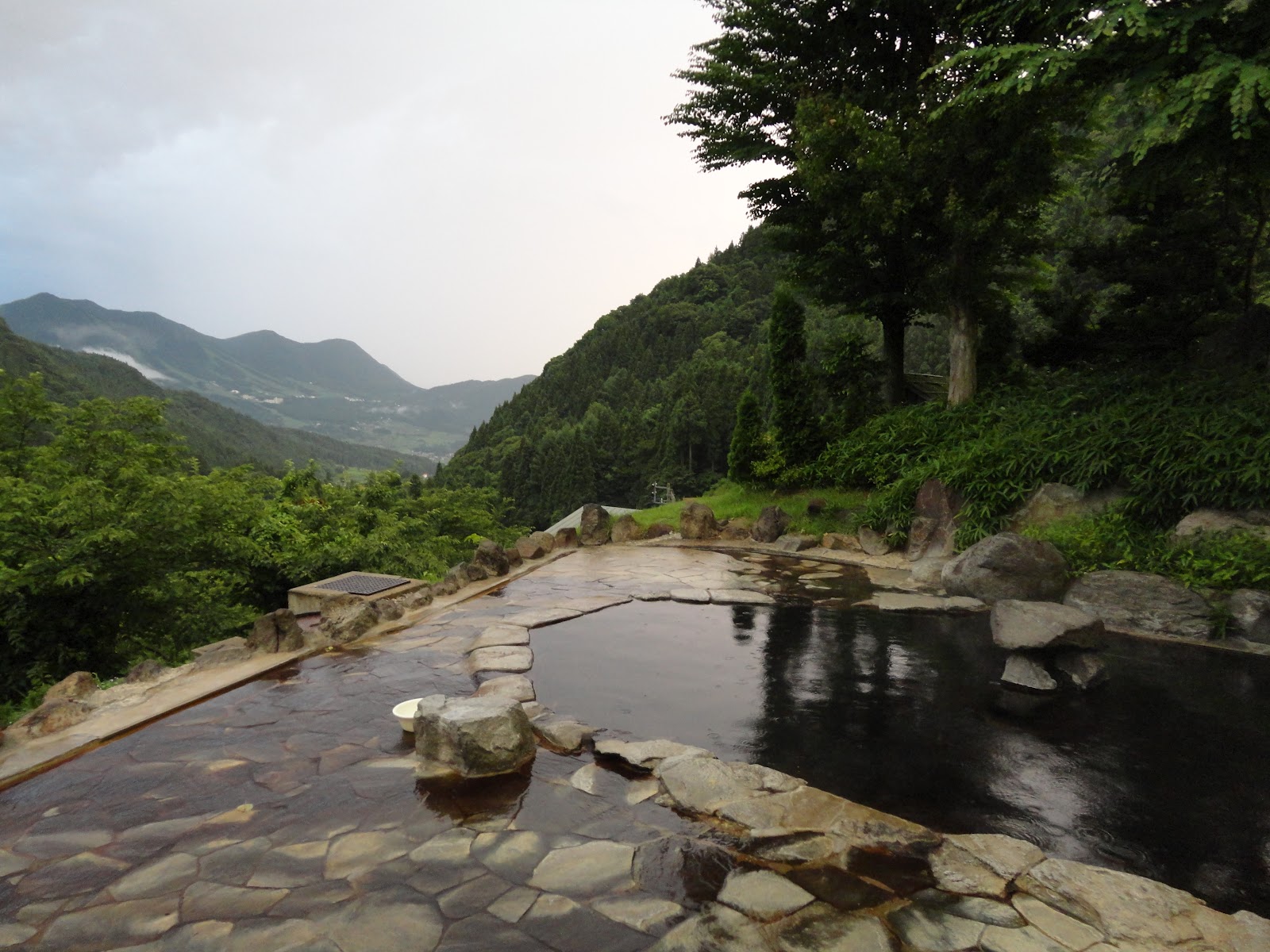
Japanese onsen (hot springs) are becoming well known outside of Japan.  There are lots of hot springs, because the Japanese archipelago is situated in an area of high volcanic activity.  It is said that you can find a source of hot spring water just about anywhere, if you drill deep enough.  In the old days, it is said that people would follow wounded animals, who were able to find natural hot springs which could help heal their injuries.  Later, more hot spring resorts were opened up as drilling technology developed, and resorts began to attract leisure travellers.  

My first hot spring experience was deep in the woods.  I had not been in Japan too long, but one of my new friends suggested going on a trip.  He was not too specific about where we were going.  I had an international driver's license (these are only good for one year, so I had not been in Japan very long at that point), so my friend said, 'We can go to my brother's place in Tochigi prefecture, and borrow his car to go on a trip!'  In the US, a driver's license is considered a birthright, almost, but in Japan, they are considerably more difficult to get (usually they require maybe 30 hours (?) of class and a big fee for the test as well, and almost no one passes the first time).  So I agreed to this plan.  The car was fairly heavy, with no power steering, stick shift, and I was not used to driving on the left, so it was a bit difficult.  Then, we headed into the mountains and started driving upriver in a narrow valley.  The road was curvy and narrow.  Meeting a car coming in the opposite directions usually required some maneuvering.  No guard rails, and I think I remember rolling down the window to look our and make sure I wouldn't drop a wheel over the edge.  Anyway, some hours passed in this way, with no help on the driving (other than navigating).  At a clearing in the woods, there was a parking lot.  My friend said 'We have to park here and walk about two hours in the woods.'  I still didn't really know where we were headed, but there was no turning back.  The walk was very peaceful, in a forest dominated by maple trees that were reaching the peak of autumnal redness.  Finally, we arrived at a very simple wooden inn in the woods.  The rooms were Japanese style, with tatami mats, and they were fairly dark because the electricity generators would not be turned on until sunset.  Also, no TV, no telephone.  The only entertainment was a 'go' board in the room.  But behind the building, in the maple forest, was a hot bath with steam curling among the branches.  After my tiring drive and walk, this seemed like heaven.  That night, it began to snow, so we enjoyed the hot bath in a snowfall.  The next day, the forest had changed from red to white.  This inn was called Kaniyu, part of the Oku-Kinugawa resort area.  I later found out that in some cases, they will offer guests a lift to the parking area--there is a road for bringing in supplies, etc., but no parking lot.  The meals were very simple, and for an extra fee, fresh tempura made with local mushrooms was available.  Also, there was no heat, but a kerosene space heater could be rented.   The outdoor bath was gender-mixed, but there were no other guests in the place that day.  There were also gender-segregated baths inside.  

Since that time, the area has been more completely developed.  The Kaniyu inn is now a four-story concrete building, with more extensive outdoor soaking facilities.  I haven't been there for many years, but apparently many guests still make the long walk through the woods as part of the experience.  

I was reminded of this experience when I found this haiku by Masaoka Shiki:   

山の湯や裸の上に天の川 'At a hot spring in the mountains, above the naked bathers, the Milky Way' (translation by me!) 

 I remember the steam rising into the night sky, and how it would seem to blend right into the Milky Way (although it was not clear enough to see it that night).  I like the shift of scale from the hot bath under your chin, up to the glowing galactic expanse. 

The photo at the top shows a public hot spring (no inn) in Nagano prefecture.